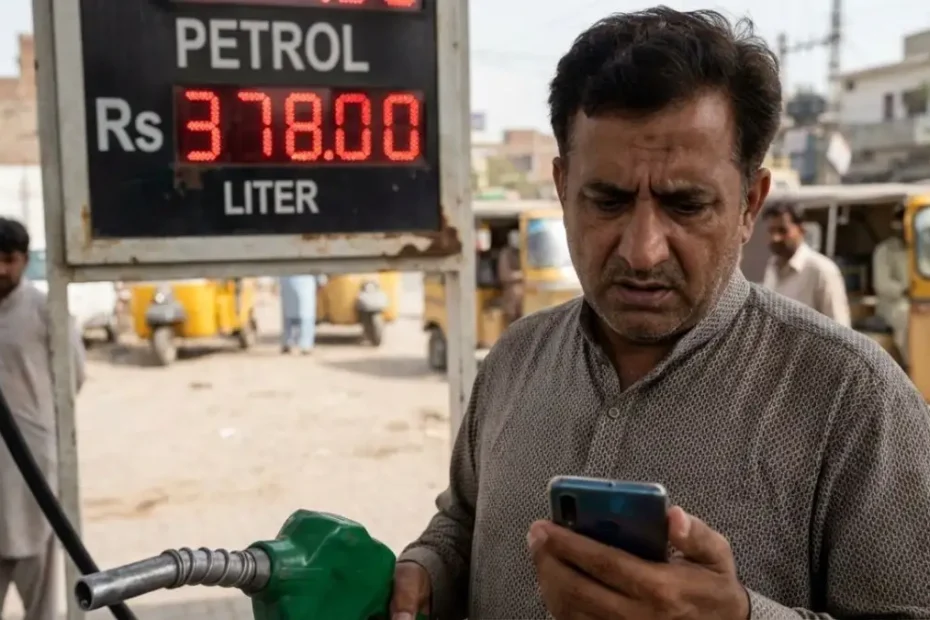
The federal government dismissed a viral social media notification on Thursday claiming the Petroleum Division had slashed fuel prices by Rs 100 per litre ahead of schedule, confirming no press release on petroleum prices had been issued and that current official rates remain unchanged. The government clarified that no press release regarding petroleum prices has been issued recently, and urged citizens to rely only on verified official sources for updates on petroleum prices.
Reports suggested OGRA had notified major reductions in petrol and diesel prices, claiming decreases of Rs 78 and Rs 100 per litre respectively. The fabricated notification stated petrol prices had fallen to Rs 300.41 per litre, while diesel prices were reduced to Rs 420.35 per litre.
The notification spread rapidly across WhatsApp and social media platforms on 10 April 2026 — the same day Pakistan woke up to global news of Brent crude crashing 15% following the US-Iran ceasefire. The timing made the fake notification credible to millions of Pakistanis expecting an out-of-cycle price cut.
As of 10 April 2026, the official pump prices across all cities in Pakistan remain:
| Product | Current Official Rate | Last Changed |
|---|---|---|
| Petrol (MS-92) | Rs 378.41/litre | 4 April 2026 |
| High-Speed Diesel (HSD) | Rs 520.35/litre | 3 April 2026 |
| Kerosene Oil | Rs 467.48/litre | 3 April 2026 |
| LPG | Rs 304.12/kg | 1 April 2026 |
Source: OGRA official notifications, ogra.org.pk.
These rates apply uniformly at all PSO, Shell, Total PARCO, Attock, Hascol, and GO outlets nationwide.
The viral notification found fertile ground because a genuine price reduction is widely anticipated. Authorities confirmed that decisions regarding revised fuel prices will be finalized after monitoring crude oil trends for two days, with reductions linked directly to international market movements. Sources reported petroleum product prices dropped by 16% after the ceasefire between Iran and the United States, easing global market pressures and stabilizing supply. The federal cabinet reviewed petroleum stocks and discussed price adjustments during its meeting.
Pakistan’s OGRA typically reviews fuel prices every 15 days, with the next scheduled revision due around 16 April 2026. However, under the current crisis framework, PM Shehbaz Sharif has authorised more frequent reviews when global market movements warrant it. The 15% crash in Brent crude from $109.27 to approximately $91–95/barrel following the 8 April ceasefire announcement creates strong mathematical grounds for a price reduction in the 16 April revision — or potentially an earlier emergency cut if prices hold.
This is not the first fake fuel notification to circulate during the current crisis. OGRA spokesperson Imran Ghaznavi previously told The Express Tribune: “The message circulating on social media regarding an increase in petrol prices is completely false and misleading. No such summary has been sent by the OGRA to the prime minister.” He added: “The public is advised not to rely on unverified social media forwards and to follow only official announcements issued by the Government of Pakistan or OGRA through verified channels.”
Pakistan’s fuel pricing system has faced a parallel crisis of disinformation running alongside the actual price crisis. At least three major fake OGRA notifications — fabricating both hikes and cuts — circulated in March–April 2026, each exploiting public anxiety around the genuine volatility in pump prices during the Strait of Hormuz disruption.
The misinformation environment intensified further after the government took decisive action at OGRA. The federal government fired the acting chairman of OGRA over the mismanagement of rising fuel costs and mysterious supply gaps. The Cabinet Division officially replaced acting chairman Shahzad Iqbal with Nabeel Ahmed Awan, a senior BS-22 officer of the Pakistan Administrative Service. Awan is currently the Secretary of the Establishment Division and has been given additional charge of the regulator for a three-month interim period.
The leadership change came after the Petroleum Division accused OGRA of failing to curb hoarding, allowing artificial shortages at pumps, and running a digital monitoring gap that let middlemen manipulate supply ahead of price revisions.
The next OGRA fortnightly review falls on 16 April 2026. Based on Brent crude now trading near $91–95/barrel versus the $109+ level at which the 3 April emergency prices were set, OGRA’s standard pricing formula points to a meaningful reduction — potentially Rs 50–80 per litre on petrol and Rs 80–100 per litre on diesel — if crude and the exchange rate (currently Rs 279–280 per dollar) hold steady through the review window.
Earlier this week, it was reported that PM Shehbaz Sharif directed the finance and petroleum ministries to ensure citizens benefit from falling global prices, initiating urgent consultations on domestic fuel adjustments.
However, Pakistan’s IMF programme obligations — including maintaining Petroleum Development Levy revenue at target levels — give the government less room to pass through crude cost savings than public expectation assumes. Finance Minister Muhammad Aurangzeb’s ministry must balance any pump-price cut against its PDL collection commitments under the third EFF review benchmarks.