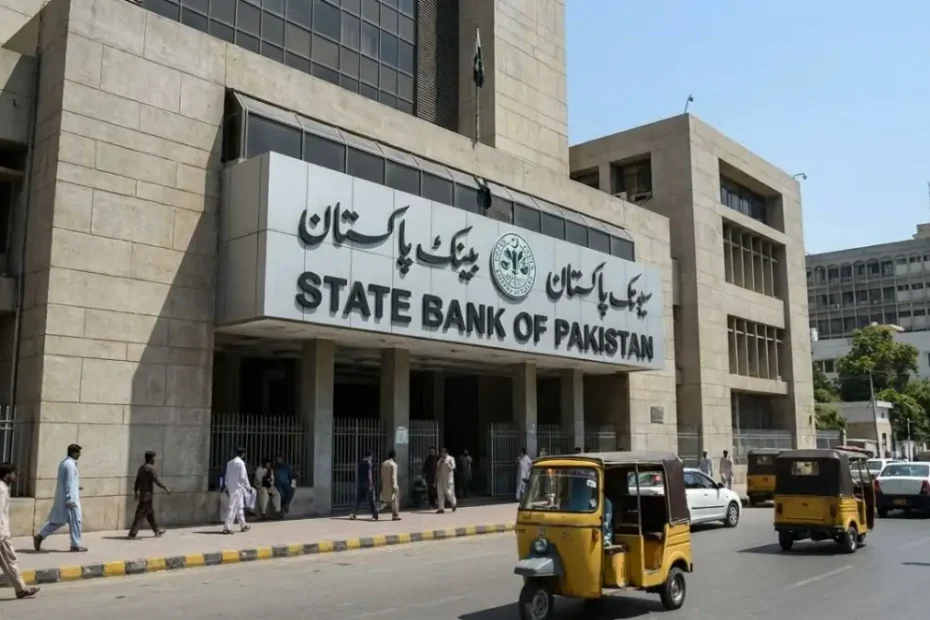
The State Bank of Pakistan on Tuesday lifted its seven-year prohibition on banks dealing with cryptocurrency companies, issuing BPRD Circular Letter No. 10 of 2026 to formally replace the landmark 2018 directive that had barred every SBP-regulated institution from processing, holding, or promoting virtual currencies. Under the new instructions, banks and all other regulated entities may now open accounts for firms holding a valid licence from the Pakistan Virtual Asset Regulatory Authority — but under a tightly ring-fenced structure that prevents banks from directly touching or investing in crypto assets themselves.
The Virtual Assets Act, 2026 has been enacted, pursuant to which PVARA has been established as the statutory authority responsible for the licensing, regulation, supervision and oversight of virtual asset activities in Pakistan. SBP Regulated Entities may open bank accounts of entities duly licensed by PVARA as Virtual Asset Service Providers, subject to strict compliance with conditions outlined in the circular.
The circular, signed by Director Syed Mansoor Ali and dated April 14, 2026, addresses all banks, Development Finance Institutions, Microfinance Banks, Electronic Money Institutions, Payment System Operators, Payment Service Providers, and Exchange Companies — the full universe of SBP-regulated entities. Its core operating instructions are:
On account structure: REs shall open separate Client Money Accounts for settlement of authorised transactions of licensed VASPs, where applicable, based on the VASP’s business model. Strict segregation between CMAs and other account types shall be ensured and commingling of VASP funds with client funds is strictly prohibited. CMAs shall be PKR-denominated, non-remunerative accounts for executing authorised transactions. Cash deposits and cash withdrawals shall not be permitted in CMAs. Funds maintained in CMAs shall not be used as collateral or to provide financing to VASPs.
On onboarding: Prior to onboarding a VASP or initiating any activity with it, REs shall obtain and retain a copy of the VASP’s valid licence issued by PVARA and independently verify its authenticity from PVARA.
On pre-licence NOC holders: Banks may also open limited-purpose accounts for entities holding NOCs issued by PVARA enabling them to complete formalities for obtaining a licence. Only upon the grant of a licence by PVARA can the bank extend additional services including virtual assets-related transactional activity.
What banks themselves still cannot do: REs shall not invest, trade or hold virtual assets using their own funds or customer deposits. REs shall remain responsible for compliance with all applicable SBP regulations including foreign exchange regulations and any arrangement with a VASP shall not absolve them of such responsibility.
Eight Years of Prohibition — The History This Circular Ends
The 2018 SBP prohibition was among the most sweeping crypto bans issued by any central bank globally. BPRD Circular 03/2018 instructed all banks, DFIs, Microfinance Banks, PSOs, and PSPs to refrain from “processing, using, trading, holding, transferring value, promoting and investing in virtual currencies/tokens” — effectively cutting every licensed financial institution off from the crypto sector entirely.
In 2018, the State Bank of Pakistan issued a circular barring banks and payment providers from dealing in virtual currencies. The Securities and Exchange Commission of Pakistan followed in 2020 with similar warnings. By 2022, a high court committee and the Federal Investigation Agency pushed for an outright prohibition citing AML and terrorism-financing concerns. As recently as 2023, the Finance Ministry stated that crypto would “never be legalized.”
The prohibition created a paradox: Pakistan became one of the world’s largest informal crypto markets, with crypto transaction volumes reaching tens of billions of dollars. The country ranked among the world’s leading adoption markets, with much activity shifting to unregulated peer-to-peer platforms as banks refused services.
The Regulatory Architecture That Made Tuesday Possible
The April 14, 2026 circular did not arrive in isolation — it is the final regulatory instrument in a chain that began with a political decision in early 2025.
The key milestones:
| Date | Development |
|---|---|
| February 2025 | Pakistan Crypto Council formed; Changpeng Zhao (Binance founder) named strategic adviser |
| May 2025 | PM Shehbaz announced 2,000 MW surplus electricity for crypto mining and AI data centres |
| May 30, 2025 | SBP clarified 2018 circular was a precautionary directive, not a declaration of illegality |
| July 8, 2025 | President promulgated Virtual Assets Ordinance 2025; PVARA established |
| August 26, 2025 | PVARA inaugural board meeting; SBP initially resisted immediate withdrawal of ban pending licensing structure |
| Early 2026 | Parliament passed Virtual Assets Act 2026 — converting temporary ordinance to permanent law |
| April 14, 2026 | SBP BPRD Circular No. 10 of 2026 — 2018 ban formally replaced with immediate effect |
At PVARA’s inaugural board meeting in August 2025, the board discussed the withdrawal of BPRD Circular No. 03 of 2018 but SBP opposed premature approval, stressing it would be problematic without a licensing structure in place. Some participants noted it may take six to eight months to put in place an effective regulatory and licensing regime. That timeline was accurate — the eight months elapsed and the licensing framework is now in place.
PVARA — Pakistan’s New Crypto Regulator
PVARA is governed by an 11-member board comprising a Chairperson, the SBP Governor, federal secretaries for the Ministries of Finance, Law and Justice, and Information Technology, Chairpersons of the SECP and FBR, the Digital Pakistan Authority, FIA Director General, and two independent directors appointed by the Federal Government.
The authority will license virtual asset service providers across eight categories including advisory services, broker-dealers, and exchanges. The framework sets out consumer safety, dispute resolution, AML/CFT standards, and Shariah compliance requirements for virtual assets.
Binance and HTX were among the first exchanges to secure PVARA licences, giving Pakistani traders access to major platforms. PVARA mandates that exchanges maintain separate bank accounts for user funds, require regular financial reporting, security audits, and insurance for certain losses.
Virtual assets remain explicitly not legal tender in Pakistan under the Virtual Assets Act — meaning they cannot be used to settle debts or make purchases in rupee-denominated transactions. Privacy coins such as Monero are banned. Capital gains on crypto transactions are taxable at 15%.
For PVARA-licensed crypto exchanges and VASPs, Tuesday’s circular unlocks the PKR banking rails they need to operate onshore legally — receiving client rupee deposits, paying out withdrawals, and settling transactions through the formal banking system for the first time since 2018.
For banks, the circular creates a carefully bounded obligation — they can serve the sector, but only through ring-fenced, PKR-only, non-remunerative Client Money Accounts with strict AML due diligence and PVARA licence verification. They cannot speculate in crypto with their own books.
For Pakistani retail users, the shift means that PVARA-licensed exchanges can now legally support PKR on-ramps and off-ramps through local bank accounts — ending the era of peer-to-peer trading, offshore workarounds, and the legal grey zone that has characterised Pakistan’s massive informal crypto market for eight years.
For FBR, the formalisation of banking access creates a taxable, traceable transaction trail for the first time — directly supporting collection of the 15% capital gains tax on crypto disposals.
Pakistani crypto holders — estimated in the tens of millions based on adoption rankings — can now access licensed, SBP-compliant exchanges with proper rupee banking integration. The key practical question is how quickly PVARA grants licences to domestic and international exchange operators and how swiftly banks build their VASP onboarding, AML due diligence, and CMA infrastructure. For businesses, the circular provides the regulatory certainty needed to formalise crypto-related payroll, treasury, and settlement operations under Pakistani law for the first time.
Legally, the framework under the Virtual Assets Act 2026 creates long-awaited certainty while preserving systemic safeguards. Allowing banking rails without balance sheet exposure strikes a pragmatic middle ground between innovation and risk containment. The real test will be supervisory coordination between SBP, PVARA, and tax authorities to prevent regulatory arbitrage.
Pingback: Pakistan Opens Banking for Crypto - CryptoLawConsult