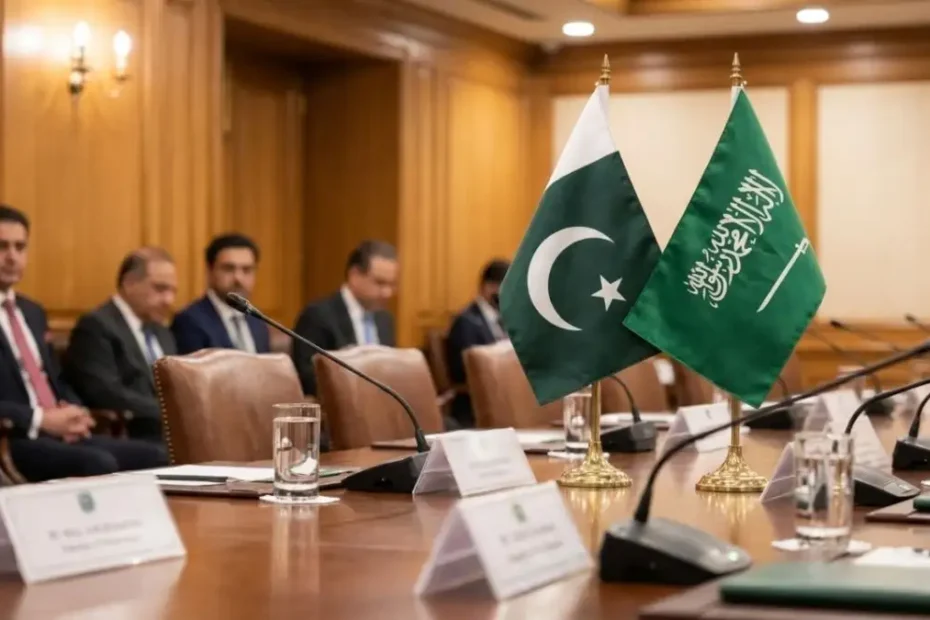
Saudi Arabia on Wednesday formalised two landmark financial commitments to Pakistan: a new $3 billion deposit to be placed at the State Bank of Pakistan within one week, and a structural conversion of the existing $5 billion Saudi deposit from an annual rollover arrangement into an open-ended facility — eliminating the recurring annual renegotiation that had kept Pakistan’s reserve managers on edge every December. The twin commitments, confirmed through Pakistan’s Finance Ministry citing FM Muhammad Aurangzeb, directly replace the $3.5 billion UAE facility that Pakistan is repaying this month and represent the largest single bilateral financial realignment in Pakistan’s external account management since the 2023 near-default.
Saudi Arabia committed additional funds with “disbursement expected in the coming week,” Pakistan’s Finance Ministry said in a statement Wednesday, citing its minister Muhammad Aurangzeb.Saudi Arabia also extended the existing $5 billion deposit, which will no longer be subject to the earlier annual rollover arrangement.
| Commitment | Amount | Key Term |
|---|---|---|
| New deposit | $3 billion | Disbursement within one week |
| Existing deposit converted | $5 billion | Annual rollover requirement removed |
| Total Saudi financial exposure post-announcement | ~$8 billion | Open-ended tenure |
The elimination of the annual rollover requirement on the $5 billion deposit is the more structurally significant of the two decisions. Under the previous arrangement, Saudi Arabia was required to formally extend its deposit each December — a process that, while consistently delivered, imposed annual uncertainty, required diplomatic engagement, and was embedded as a performance condition in Pakistan’s IMF programme. Removing that requirement converts a fragile annual renewal into a durable, programme-supportive instrument.
Saudi Crown Prince Mohammed bin Salman pledged $3 billion in financial support to Pakistan, to be deposited in the State Bank of Pakistan. Reports said the Crown Prince recently sent Saudi Arabia’s finance minister on a brief visit to Islamabad to assure Pakistani leadership that the Gulf country would help cover any potential foreign exchange shortfall. Officials called this an “extraordinary measure,” highlighting the strategic trust and strong bilateral relations between the two countries. Prime Minister Shehbaz Sharif is expected to visit Saudi Arabia soon, where he will meet the Crown Prince to formally thank Saudi leadership for their timely support.
Saudi Finance Minister Mohammed bin Abdullah Al-Jadaan held discussions in Islamabad with Prime Minister Shehbaz Sharif on economic cooperation and regional developments. The talks were also attended by Foreign Minister Ishaq Dar and Army Chief General Asim Munir.That meeting on April 11 — the same day the first direct US-Iran talks since 1979 opened at the Serena Hotel in Islamabad — set the stage for Wednesday’s formal announcement. FM Aurangzeb, already in Washington for IMF/World Bank Spring Meetings, confirmed the deal on Pakistan’s behalf.
The arithmetic of Saudi support resolves Pakistan’s most acute near-term reserve problem:
| Reserve Scenario | SBP Reserves |
|---|---|
| Pre-announcement (April 14) | ~$16.4 billion |
| After UAE repayments (Apr 11–23) | ~$12.9 billion (est.) |
| After $3bn Saudi deposit (this week) | ~$15.9 billion |
| IMF June 2026 target | $18.0 billion |
| Remaining gap (incl. ~$1.3bn IMF tranche) | ~$0.8 billion |
Without fresh inflows, officials feared reserves could fall to around $11.5 billion, adding pressure to the external account.The Saudi commitment, combined with the ~$1.3 billion IMF EFF+RSF tranche expected from the board meeting in late April or early May, puts the $18 billion June IMF target back within reach — though the margin remains thin.
The original $3 billion deposit was initially signed with the SBP in 2021 and subsequently rolled over in 2022, 2023, and 2024. The deposit most recently due to mature on December 8, 2025, was extended for another year to December 2026. A further $2 billion was added in July 2023, bringing total Saudi deposits to $5 billion.
Saudi Arabia remained the major source of cheap foreign loans for Pakistan, rolling over $5 billion in loans at an annual interest rate of 4% — about one-third cheaper than Chinese cash deposits and less than half the cost of foreign commercial borrowing.
The conversion of this $5 billion from an annually-renewed instrument to an open-ended facility eliminates the single largest source of recurring bilateral financing uncertainty in Pakistan’s external account calendar. It also directly satisfies one of the IMF EFF programme’s key structural requirements — that bilateral creditors maintain their financial exposure for the duration of the 37-month programme running to October 2027.
Pakistan’s April 2026 financial support from Saudi Arabia arrives against a backdrop of deepened security cooperation. In parallel with economic developments, Pakistan strengthened its military coordination with Saudi Arabia under a mutual defence pact. Pakistani fighter jets and personnel have been deployed to King Abdulaziz Air Base, according to Saudi defence officials. Reports suggest Islamabad has already sent around 13,000 troops, with the potential for a much larger deployment in the coming weeks.
Saudi Arabia’s financial commitment thus reinforces a security relationship that has materially deepened since the Iran war began on February 28, 2026. Pakistan’s simultaneous roles as Iran-US ceasefire mediator and Saudi military partner created a uniquely leveraged diplomatic position — one that FM Aurangzeb deployed in Washington while MBS delivered the financial commitment from Riyadh.
The IMF’s $7 billion EFF requires Pakistan’s three bilateral creditors — Saudi Arabia, China, and the UAE — to maintain their deposits at the SBP throughout the programme period. The UAE’s exit, while diplomatically managed, created a technical gap in this bilateral financing assurance framework. Saudi Arabia’s new $3 billion deposit and the conversion of its $5 billion facility to open-ended tenure more than compensates, increasing Saudi Arabia’s share of bilateral programme support from ~$5 billion to ~$8 billion — effectively substituting for the UAE entirely while strengthening the overall bilateral cushion.
For the IMF board meeting expected in late April or early May — which will formally unlock ~$1 billion under EFF and ~$210 million under RSF — Wednesday’s Saudi announcement removes the most pressing concern that had loomed over the board’s reserve adequacy assessment.