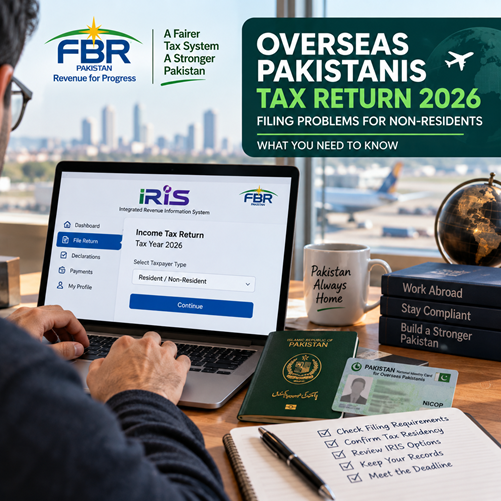
Overseas Pakistanis Face Tax Return 2026 Filing Problems: What Non-Residents Should Know
Overseas Pakistanis are facing difficulties while filing their Income Tax Returns for Tax Year 2026 following the reported removal of the dedicated Non-Resident return from FBR’s IRIS portal.
According to a report published on September 21, tax professionals have raised the issue with the Federal Board of Revenue (FBR), saying the change has created uncertainty for Pakistanis living abroad who want to file their returns correctly.
For Tax Year 2026, IRIS reportedly provides a single generic income tax return containing a “Resident/Non-Resident” option, instead of the separate non-resident return previously available.
What Has Changed in IRIS for Tax Year 2026?
According to the complaint reported by Business Recorder, IRIS offered a dedicated return for certain non-resident Pakistanis through Tax Year 2025.
For Tax Year 2026, that dedicated return is reportedly no longer available.
Instead, taxpayers are seeing the general return with an option to specify whether they are resident or non-resident.
The current form also reportedly provides an option concerning whether a Wealth Statement is required. Tax professionals have argued that overseas filers need clearer instructions on how these options should be used.
Who Is a Non-Resident for Pakistan Income Tax?
Simply living or working overseas doesn’t automatically answer the tax-residency question.
Under Section 82 of the Income Tax Ordinance, an individual is generally resident for a tax year if the person meets specified presence tests, including being present in Pakistan for 183 days or more during the tax year.
Another test can apply where a person spends 120 days or more in Pakistan during the tax year and 365 days or more in aggregate during the preceding four years.
Certain government employees posted abroad are also treated as resident individuals.
A person who isn’t resident under the applicable rules is treated as non-resident for the tax year under Section 81.
This means overseas Pakistanis should establish their tax residency based on the law rather than simply selecting “Non-Resident” because they currently live abroad.
Why Do Some Overseas Pakistanis File Returns?
An overseas Pakistani may still have reasons or obligations to interact with Pakistan’s tax system.
For example, a non-resident may have Pakistan-source income such as:
- Rental income from property in Pakistan
- Income connected with a business in Pakistan
- Certain capital gains
- Profit or investment income
- Other Pakistan-source income
FBR’s own guidance identifies several types of Pakistan-source income and separately defines foreign-source income.
Some non-residents may also file voluntarily for purposes connected with their tax status or financial dealings in Pakistan.
The exact filing requirement depends on the person’s circumstances.
Why Is the Missing Form Causing Concern?
The problem isn’t simply that the IRIS interface looks different.
Tax professionals argue that without a dedicated form or clear instructions, some overseas taxpayers may be uncertain about:
- Which return fields they need to complete
- How to declare non-resident status
- Whether a Wealth Statement is required
- How Pakistan-source income should be reported
- Whether irrelevant sections can safely be left blank
- Whether the return will correctly reflect their non-resident position
A formal complaint cited in today’s report asks FBR either to restore the previous dedicated Non-Resident return or issue official guidance explaining how non-residents should use the current combined return.
What About the Wealth Statement?
This is one area where overseas taxpayers should be particularly careful.
FBR’s general return-filing guidance says completing an income tax return normally involves the Return of Income and Wealth Statement, with reconciliation required before successful submission.
However, the current Tax Year 2026 issue specifically concerns how the generic form applies to non-residents and its Wealth Statement option.
Taxpayers shouldn’t assume that the requirements applying to a resident individual automatically apply in exactly the same way to every non-resident.
The person’s tax status, income and applicable provisions should be considered.
Don’t Declare Yourself Non-Resident Without Checking
An overseas Pakistani should not select “Non-Resident” merely because they hold a foreign visa, work permit or residence permit.
Tax residence is determined under Pakistan’s income tax rules.
For example, the number of days spent in Pakistan can be important.
Keep records such as:
- Passport entry and exit dates
- Travel history
- Employment information
- Foreign residence documentation
- Pakistan-source income records
- Property and investment records
These documents can help establish the correct tax position if required.
Overseas Pakistanis and Property Transactions
FBR already has special procedures relevant to some overseas Pakistanis.
FBR’s official FAQ states that qualifying overseas Pakistanis holding a POC or NICOP who are non-resident can, under the specified procedure, obtain filer-rate treatment for advance income tax under Sections 236C and 236K in relation to immovable property even where they haven’t filed a return.
This is separate from the current Tax Year 2026 return-form issue, but it shows why taxpayers shouldn’t assume that all rules applying to resident filers work identically for overseas Pakistanis.
September 30 Deadline Is Approaching
The timing of the issue is important.
FBR’s official due-date guidance lists September 30 as the normal income tax return deadline for individuals and Associations of Persons.
With only days remaining, uncertainty about the correct filing procedure can create practical problems for overseas taxpayers.
The complaint reported on September 21 has therefore also requested a proportionate filing deadline extension for the affected category.
Importantly, that is a request for an extension, not confirmation that FBR has granted one.
What Should Overseas Pakistanis Do Now?
Overseas taxpayers should first determine whether they actually have a filing obligation and whether they qualify as resident or non-resident for Tax Year 2026.
If filing is required or being done voluntarily, carefully review the current IRIS return before submission.
Don’t guess about residency, Wealth Statement requirements or Pakistan-source income merely to get the return submitted.
Where the current form doesn’t clearly accommodate the taxpayer’s circumstances, consider seeking professional tax advice and monitor FBR for an official clarification.
FBR confirms that income tax returns are filed electronically through IRIS.
Has FBR Restored the Non-Resident Form?
As of the reporting published on September 21, 2026, the complaint stated that the dedicated Tax Year 2026 Non-Resident return had not been restored and requested FBR intervention.
TaxToday.pk will monitor the situation because IRIS can be updated and FBR may issue clarification after the complaint.
Readers should therefore check the current IRIS portal and latest FBR instructions before filing.
Note
The main issue isn’t whether overseas Pakistanis can use IRIS. The concern raised by tax professionals is the absence of the previous dedicated Non-Resident return and uncertainty about correctly using the generic Tax Year 2026 return.
Overseas Pakistanis should not make assumptions about their residency status or filing requirements.
Check your days of presence in Pakistan, identify any Pakistan-source income, maintain supporting records and follow any clarification subsequently issued by FBR.