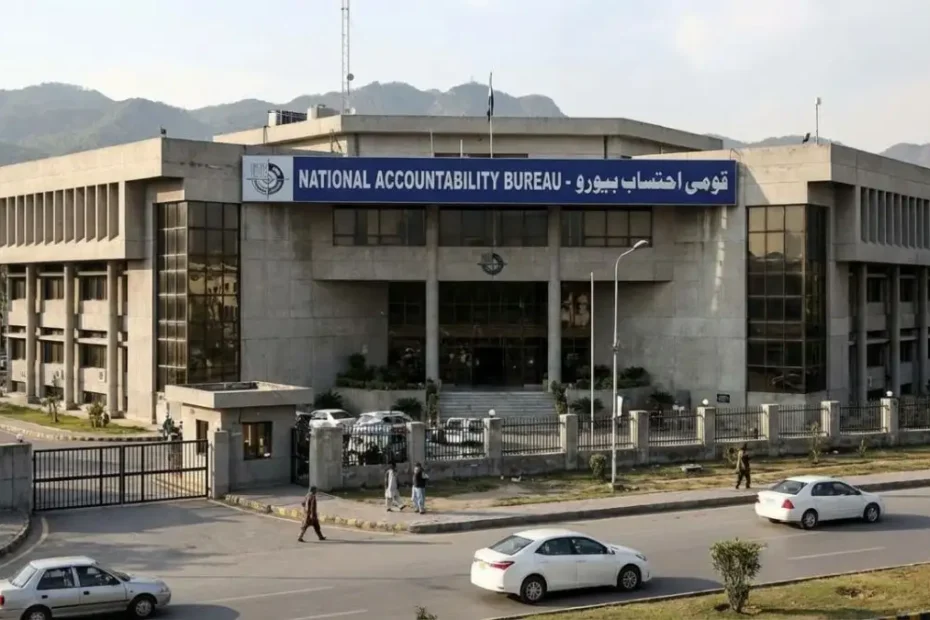
The National Accountability Bureau uncovered evidence of Rs 5 billion in alleged corruption in the Sindh government’s Roshan Sindh Program on Tuesday, finding more than 17 fake import declarations, forged import documents, and systematic over-invoicing that investigators say caused major losses to the national exchequer — while billions of rupees were allegedly funnelled abroad and used to purchase expensive properties in Dubai. NAB sources confirmed the inquiry has widened in scope, with suspects including Mehfooz Qazi, Mudassar Qazi, Jafar Khawaja, and Aoun Khawaja summoned, and additional high-profile individuals identified as potentially linked to the fraud.
According to NAB sources, more than 17 fake import declarations were used in the project, while forged import papers and over-invoicing allegedly caused major losses to the national exchequer. NAB sources said billions of rupees were allegedly moved abroad through fraudulent means, with expensive properties reportedly purchased in Dubai.
The alleged fraud follows a pattern common in government infrastructure projects: inflating the import value of goods — in this case, solar panels and related equipment — through forged customs declarations, receiving payment at the inflated rate, and remitting the difference between the real and declared import cost to offshore accounts. Dubai’s real estate market, which accepts large cash transactions and has historically attracted funds from Pakistani corruption cases, is specifically named as the destination.
| Alleged Fraud Element | Detail |
|---|---|
| Total alleged loss | Rs 5 billion |
| Fake import declarations | More than 17 |
| Method | Forged import papers + over-invoicing |
| Proceeds | Allegedly moved abroad |
| Offshore property | Expensive real estate in Dubai |
| Legal instrument | National Accountability Ordinance, 1999 |
Project figures including Mehfooz Qazi, Mudassar Qazi, Jafar Khawaja, and Aoun Khawaja have been summoned in connection with the inquiry. Investigators have already recorded the statement of one suspect, while two others have been called in on April 15. The inquiry has also uncovered indications that more influential individuals may be linked to the case.
The summoning of four individuals — two from the Qazi family and two from the Khawaja family — suggests NAB’s investigation has zeroed in on contractor networks that handled the procurement and import of the solar equipment. The mention of “more influential individuals” is a signal that the probe may extend beyond the direct contractors to government officials who approved, awarded, or supervised the project.
The Roshan Sindh Programme was approved by the Sindh government on September 22, 2014, with the stated objective of installing 20,000 solar-powered streetlights across major municipal areas of the province by June 2016. The project was budgeted at Rs 4 billion and was formally linked with the wider fake accounts mega-case in NAB’s subsequent investigations.
The programme was approved under former Chief Minister Syed Qaim Ali Shah and administered during a period when the PPP held uninterrupted provincial power. Solar streetlights were installed on select roads in certain cities while large portions of designated areas reportedly remained unserved — a discrepancy investigators attributed to funds being diverted rather than equipment being procured.
NAB previously investigated the case extensively between 2019 and 2022. The Sindh Roshan Programme case relates to the installation of solar-powered street lights allegedly through illegal contracts in various districts of Sindh. NAB officials had earlier said that they had recovered Rs 298 million in the Sindh Roshan Programme case, and some of the accused — Abdul Sattar Qureshi, Abdul Rashid Chana, Aslam Pervaiz Memon, and Baldev — had agreed to enter plea bargains.
The April 2026 development signals the inquiry has now widened significantly beyond the earlier plea-bargain-level accused to a fresh set of individuals and a substantially higher alleged loss figure — from Rs 4 billion in original project cost to Rs 5 billion in alleged corruption alone.
The allegation that proceeds were invested in Dubai real estate adds a money-laundering dimension to the existing corruption and over-invoicing charges. Under Pakistan’s Anti-Money Laundering Act, 2010, and National Accountability Ordinance, 1999, NAB holds jurisdiction over both the underlying corruption offence and proceeds laundered abroad. Pakistan’s Financial Monitoring Unit (FMU) and FIA can also be drawn into the investigation if Dubai-based property records are accessed through UAE-Pakistan judicial assistance channels. Dubai’s land registry, which records nationality of purchasers, has been used by Pakistani authorities in several prior high-profile corruption cases to trace funds.
The timing carries significance. Pakistan’s IMF $7 billion EFF third review concluded at staff-level on March 28, 2026, with governance reforms — including anti-corruption enforcement — embedded as structural benchmarks. The IMF’s 2025 Governance Diagnostic Assessment had specifically cited NAB’s credibility issues and the need for effective anti-corruption enforcement. A high-profile inquiry showing fresh evidence in a decade-old mega-project corruption case, with fresh suspects summoned, sends a visible signal about the state of accountability proceedings ahead of the Executive Board meeting expected in late April or early May that will formally unlock Pakistan’s ~$1.3 billion EFF+RSF tranche.
The Roshan Sindh Programme case has a long institutional history. In 2019–2020, NAB Rawalpindi assumed jurisdiction after the case was linked to the fake bank accounts mega-case. Sindh CM Murad Ali Shah appeared before NAB Rawalpindi in June 2020 as he had served as Sindh Finance Minister when the scheme was approved. Former CM Qaim Ali Shah also appeared before investigators and submitted answers to 20 NAB questions. PPP leader Sharjeel Memon challenged NAB proceedings in the Islamabad High Court. Plea bargains worth Rs 75 million were entered by several contractors. The April 14, 2026 developments represent a new phase of the inquiry — wider in scope, higher in alleged loss quantum, and focused on a fresh set of individuals beyond those already processed through the earlier accountability proceedings.