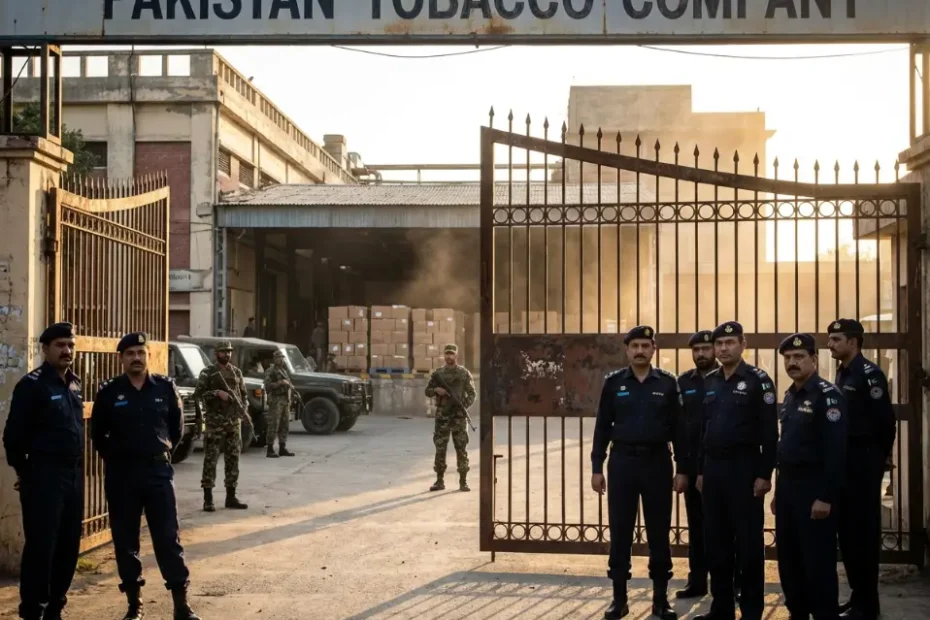
There’s a tug of war going on right now between Pakistan’s tobacco sector and the Federal Board of Revenue — and neither side shows any sign of backing down.
Tobacco dealers, factory owners, and trade associations from Swabi to Karachi have come out strongly against what they’re calling heavy-handed government interference. Meanwhile, the FBR insists it has no choice: the illicit tobacco trade is costing the national exchequer anywhere between Rs 250 billion and Rs 400 billion every single year, and someone has to answer for it.
So what exactly is happening, and who actually has a point?
The Flashpoint: Rangers at the Factory Gate
Members of the Swabi Chamber of Commerce and Industry, along with leading tobacco industry figures, have publicly condemned the deployment of FBR officials, Rangers, and other law enforcement agencies at tobacco green leaf units and factories. A formal meeting was convened to discuss the matter, attended by Chamber President Fazal Rahim Jadoon, former presidents, and senior members of the tobacco trade from across Khyber Pakhtunkhwa.
The participants pointed out that tobacco procurement was currently underway, and the presence of Rangers personnel and FBR officials inside factories was creating serious difficulties for their day-to-day operations.Industry representatives argued that this kind of deployment, during one of the most critical periods of the procurement calendar, amounted to direct interference in legitimate business.
This wasn’t the first time the issue had been raised. The chamber’s subcommittee on tobacco export and trade had already staged a protest the previous week against the presence of law enforcement officials at factories, calling it unwarranted intrusion.
What the FBR Says It Found
The government’s side of the story paints a very different picture. FBR enforcement teams conducted a high-profile raid at M/s Pioneer Tobacco & Trading Company, located in the Export Processing Zone in Karachi, and what they reportedly uncovered raised serious concerns across regulatory, public health, and fiscal circles.
The raid resulted in the seizure of approximately 4.5 million foreign cigarette sticks, including well-known international brands. Authorities also recovered cigarette filters, packing material, and expired sheesha flavours — items officials suspect were being used to repackage and relabel old cigarette stock.
The alleged operation, according to investigators, works something like this: expired or near-expiry cigarette stocks are purchased from international black markets at extremely low prices — often products rejected by authorised distributors due to shelf-life concerns — and acquired in bulk for a fraction of their original cost. They’re then allegedly brought into Pakistan through EPZ facilities, repackaged under familiar brand names, and diverted into the domestic market, completely bypassing excise duties and sales tax.
Both Pakistan Tobacco Company (owner of Benson & Hedges) and Philip Morris International (owner of Marlboro) were contacted by investigators. Both confirmed that such activity is illegal and stated that M/s Pioneer Tobacco & Trading Company has no authorisation from the brand owners to import, manufacture, or export their products.
How Big Is the Problem, Really?
The numbers here are sobering. The illicit tobacco market in Pakistan now exceeds a 50% share of total cigarette consumption, causing annual losses of over Rs 400 billion to the national exchequer. To put that in perspective, that’s money that could fund hospitals, schools, or infrastructure — gone.
Industry estimates suggest that the share of smuggled cigarettes in the total market reached 11 percent in 2025 alone, resulting in billions of rupees in lost tax revenues due to evasion. And that figure only accounts for smuggled stock — it doesn’t include locally produced non-duty-paid cigarettes, which make up a far larger chunk.
The FBR has deployed more than 200 monitors across production facilities nationwide and assigned around 120 Pakistan Rangers personnel to secure Green Leaf Threshing units, with officials saying this is intended to prevent unauthorised production and strengthen on-site surveillance.
The Courts Get Involved
The standoff has spilled into the legal arena as well. The Peshawar High Court directed the FBR to de-seal 26 cigarette factories in Khyber Pakhtunkhwa that had been shut down for defying orders to install CCTV cameras on their premises.The court issued notices to the FBR chairman and other senior officials, directing that no further adverse action be taken against the petitioning companies pending the next hearing.
The tobacco companies argued in court that they had already complied with tracking and tracing requirements introduced in 2019, and had installed the electronic monitoring system at substantial cost — making the additional CCTV demand a fresh and legally questionable imposition.
The FBR then appealed to the Supreme Court against the PHC’s de-sealing order, arguing that the high court’s directive was not in accordance with the law and could have significant implications for the regulation of the tobacco industry and the enforcement of tax laws. That case is still pending.
In Karachi, after the Pioneer Tobacco raid, M/s GB Global — owned by the same business group — approached the court of the Senior Civil Judge in Malir and successfully obtained a stay order restraining FBR officials from conducting further raids on its premises.
Political Connections Come Into the Picture
The crackdown has also brought some uncomfortable political connections to the surface. FBR’s Directorate of Intelligence & Investigation in Multan seized 2.5 million non-duty-paid cigarettes near Sham Kot Ada. The seized brands — Boss and Canton — are registered under Sarhad Tobacco Company, Swabi, reportedly owned by Sheeraz Akram Bacha, a senior PML-N leader from Khyber Pakhtunkhwa and a former provincial minister.
Officials confirmed that the Intelligence Bureau had been actively assisting FBR in these enforcement efforts, and stated that similar actions would be taken against other entities involved in tax evasion, regardless of political affiliation or industry standing.
What About the Health Angle?
Beyond the tax debate, there’s a public health dimension to this that often gets buried in the back-and-forth. Expired cigarettes aren’t just an accounting problem — they’re a direct risk to consumers. According to industry sources, the typical shelf life of cigarettes ranges from three to six months. Beyond this period, tobacco dries out, becomes stale, loses flavour integrity, and undergoes chemical degradation, which may lead to mould formation, rendering the product unfit for human consumption.
Cigarettes that are already harmful become measurably worse once they’ve expired. Consumers buying cheap cigarettes off a local paan shop have absolutely no way of knowing what they’re actually smoking.
The Lahore Push
The crackdown isn’t limited to factories. Following government directives, a new enforcement committee has been formed in Lahore tasked with conducting a comprehensive survey and inspection of all retail outlets within three days, followed by sustained enforcement operations over three months. All illegal cigarettes found during inspections are to be confiscated immediately, and in cases involving large-scale violations, officials have been empowered to seal shops for up to seven days.
Where Does This Leave Things?
The honest answer is that both sides have legitimate grievances — but they’re not equally weighted.
The tobacco industry’s concerns about procedural fairness, especially around the timing of enforcement during active procurement season, deserve to be heard. Businesses can’t function properly with Rangers standing inside their facilities during peak operational periods, and courts have found merit in some of their legal challenges.
But the scale of tax evasion and the public health risk from repackaged expired products are serious enough that the government can’t simply look the other way. The FBR’s crackdown is seen as part of a broader push to restore compliance and reinforce revenue collection in Pakistan’s tobacco sector and with hundreds of billions of rupees at stake every year, the pressure to act isn’t going away any time soon.
What Pakistan needs, ultimately, is a structured regulatory framework — one where legitimate businesses aren’t harassed and genuine bad actors can’t hide behind legal delays. Whether the current approach achieves that balance is a question the courts, and eventually policymakers, will have to answer.