
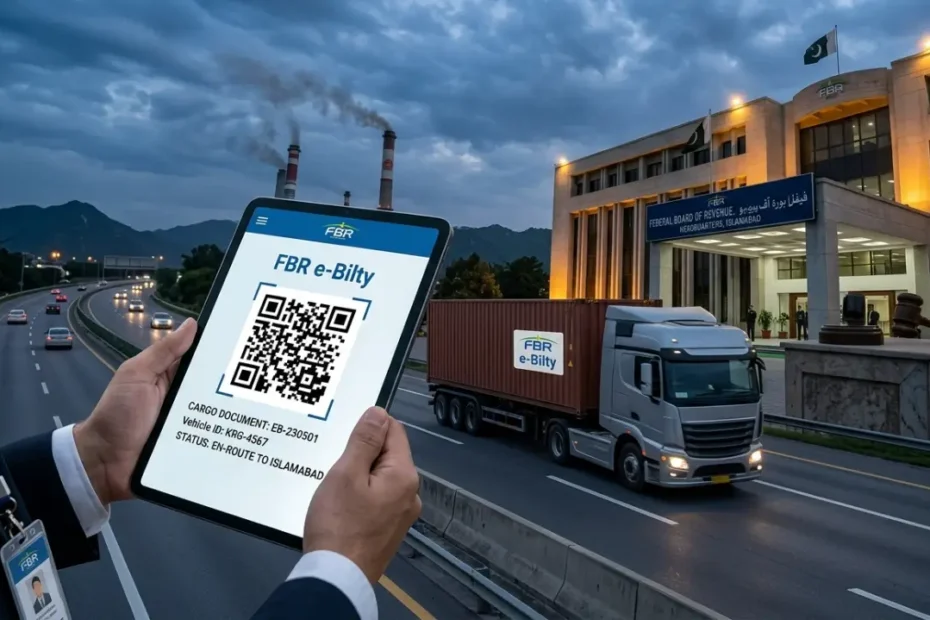
Source review — 2 October 2026: This page distinguishes an e-Bilty feasibility project from an operative nationwide requirement. We removed unsupported claims about a live central portal, mandatory replacement of every paper bilty and real-time integration with particular agencies. Earlier overlapping coverage is being consolidated here.
What the primary record confirms
FBR’s official tender register lists tender 4437, uploaded 10 September 2025, for a strategic feasibility assessment and solution design for a National Cargo Tracking System with an e-Bilty mechanism. The listed closing date was 8 October 2025. This is a dated project record, not a current invitation or a notification directing every business to stop using paper documents.
A feasibility or procurement milestone does not, by itself, identify who must file, the operative date, the required portal, penalties or exemptions. A business should check the applicable legal notification and official instructions before changing its filing process.
Prepare a dispatch record without assuming a new mandate
TaxToday’s suggested preparation is to reconcile the records already used in a shipment. Keep a reference linking the invoice, delivery note, transporter document, vehicle details and proof of receipt. This makes discrepancies easier to explain whether the records are on paper or in software.
- Goods: description, units, quantity and any shipment reference used consistently across the documents.
- Parties: supplier, recipient and transporter details checked against the commercial documents.
- Movement: dispatch date, origin, intended destination and changes agreed during transport.
- Exceptions: shortages, returns, damaged goods, split loads or cancelled dispatches, with the reason and supporting record.
A simple reconciliation example
If an invoice covers 100 cartons but the first truck carries 60 and a second truck carries 40, record the two dispatches against the one invoice. Do not create the appearance that both trucks carried the full invoiced quantity. If ten cartons are returned, retain the return reference so the delivery and accounting records can be followed.
This example explains record consistency; it does not specify an FBR e-Bilty field, tax treatment or filing deadline.
Before adopting a new system
Ask for the official instructions identifying the covered businesses, goods or routes; effective date; registration process; document fields; correction procedure; and arrangements during system failure. Keep the document version and date with your internal procedure. A software vendor’s advertisement or news headline should not be treated as the legal instruction.
Transport documentation, a sales-tax invoice and a tax return have different functions. A digital transport record alone does not prove that the related tax has been declared or paid. See our FBR updates and filing guides for separate developments.
Reviewed by Faisal Hamid Khosa on 2 October 2026. This is independent preparation guidance and a description of the cited historical tender. It does not confirm nationwide launch or a universal e-Bilty obligation.