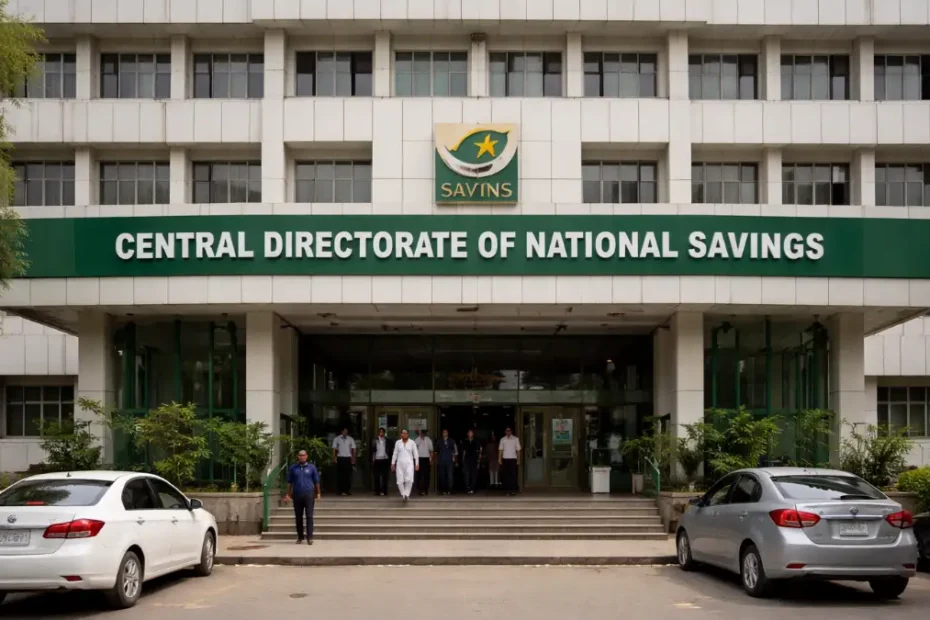
The Finance Ministry formally transferred the Central Directorate of National Savings (CDNS) from the Budget Wing to the Debt Management Office (DMO) under the Finance Division on Tuesday, effective from March 2026 — a structural reform that places Pakistan’s largest savings institution, managing over Rs 3.4 trillion across 7 million investor accounts, directly under the same office responsible for managing all government domestic and external debt. The decision was taken on the recommendation of a committee formed by Finance Minister Muhammad Aurangzeb and headed by his Adviser on Debt, who reviewed CDNS operations in full before recommending the transfer.
The government formally transferred the business operations of CDNS from the Budget Wing to the Debt Management Office under the Finance Division, with immediate effect. Under the new arrangement, CDNS’s policy, operational, and administrative functions have been placed under the Debt Management Office. According to the Ministry of Finance, the restructuring aims to improve the efficiency and effectiveness of the National Savings system. The notification states that the change has been approved by the Finance Secretary, and relevant sections may update job descriptions in consultation with concerned departments.
In practical terms, this means the Joint Secretary (Budget) — who previously supervised CDNS on an informal basis as an attached department — no longer holds supervisory authority over the organisation. All policy decisions on NSS profit rates, product design, inflow targets, and administrative operations now fall under the DMO.
The Budget Wing and the Debt Management Office perform fundamentally different functions within the Finance Division. The Budget Wing is primarily responsible for preparing the annual federal budget and managing expenditures, while the Debt Management Office handles the management of government debt. Through National Savings schemes, the government mobilizes public savings, collecting funds via various investment and savings instruments.
CDNS is, at its core, a domestic debt instrument — not a budget expenditure manager. Every rupee invested in National Savings Certificates, Behbood Certificates, Special Savings Certificates, or Defence Savings Certificates represents a liability of the federal government. Those liabilities are denominated in rupees, carry fixed profit rates, and mature at defined intervals — which is precisely the kind of debt profile the DMO is structured to manage, monitor, and optimise.
On the domestic debt side, debt origination is handled by three entities: the Budget Wing of MOF, the Central Directorate of National Savings (CDNS), and the Domestic Markets and Monetary Management Department of SBP. With CDNS now under the DMO, the government consolidates two of these three debt origination channels under a single roof — streamlining the coordination between Treasury bill/PIB issuance and NSS issuance that previously required inter-wing communication.
The transfer was not a routine administrative shuffle. A formal committee — convened by Finance Minister Aurangzeb and chaired by his Adviser on Debt — reviewed CDNS operations end-to-end before recommending the restructuring. The timing aligns directly with FM Aurangzeb’s parallel push to strengthen the DMO’s capabilities. In Washington on Monday, Aurangzeb sought World Bank and IFC support on debt management, stressing the value of knowledge sharing and capacity building, and sought enhanced technical support, advanced analytical tools, and specialised training for Pakistan’s Debt Management Office to improve long-term financial resilience. The adviser of the Ministry of Finance’s Debt Management Office would act as the focal person for coordinating collaborative programmes with the World Bank Group.
The CDNS transfer and the World Bank DMO capacity-building request, both occurring in the same week, form a coherent policy sequence: upgrade the DMO’s analytical and operational capacity first, then consolidate CDNS under it to deliver an integrated domestic debt management architecture.
CDNS recorded Rs 1,210 billion in savings inflows from July 1 to April 10 of FY2025–26, representing 76.92% of its annual target of Rs 1.3 trillion. The directorate has earmarked Rs 50 billion for investments in Islamic savings instruments during FY2025–26, aiming to promote Shariah-compliant financial products and support the expansion of the Islamic economy.
| Metric | Figure |
|---|---|
| Total portfolio under management | Rs 3.4 trillion+ |
| Active investor accounts | 7 million |
| FY26 inflow target | Rs 1.3 trillion |
| FY26 inflows (Jul–Apr 10) | Rs 1,210 billion (76.92% of target) |
| Islamic savings target FY26 | Rs 50 billion |
| National Savings Centres | 376 branches, 12 regional directorates |
For the 7 million Pakistanis — retirees, widows, senior citizens, and conservative savers — holding National Savings products, the administrative transfer does not change the sovereign guarantee behind their investments, the profit rates currently on offer, or the process for transacting at their nearest National Savings Centre. NSS profit rates are linked to government borrowing costs (T-Bills and PIBs), and that linkage mechanism remains unchanged.
What changes over the medium term is the quality of decision-making around NSS rate-setting, product design, and liability management. With the DMO now overseeing CDNS directly, profit rate decisions on NSS instruments will be taken within the same analytical framework used to price T-Bills and PIBs — meaning tighter coordination between retail savings rates and wholesale debt market rates, and less scope for misalignment between the two that historically created arbitrage and distortions.
With the SBP policy rate at 10.5%, NSS rates currently reflect a significant premium over T-bill rates for retail investors — a feature that has driven the Rs 1.2 trillion inflow surge this fiscal year. The DMO’s takeover of CDNS creates a structural incentive to align NSS yields more tightly with market rates over time, which could affect the attractiveness of NSS products for retail investors in future rate cycles.