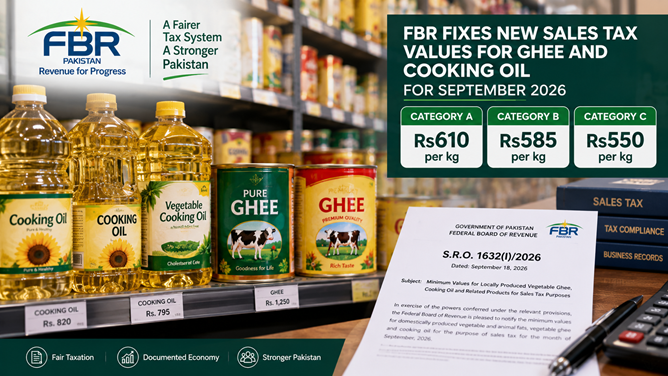
The Federal Board of Revenue (FBR) has fixed new minimum values for locally produced vegetable ghee, cooking oil and related edible fats for the purpose of calculating sales tax during September 2026.
The new values have been notified through S.R.O. 1632(I)/2026 dated September 18, 2026.
The notification sets different minimum values according to the category of product and brand, meaning manufacturers cannot calculate sales tax using a value below the prescribed amount for the applicable category.
What Has FBR Changed?
FBR has prescribed minimum values for specified domestically produced vegetable and animal fats, vegetable ghee and cooking oil.
These values will be used for calculating sales tax for the relevant period.
The measure is important because sales tax liability depends partly on the value on which the applicable tax rate is calculated.
Where the prescribed minimum value applies, a manufacturer cannot simply declare a lower value for sales tax calculation purposes.
Three Categories of Ghee and Cooking Oil
FBR has divided the relevant products into three categories for valuation purposes.
According to the notification, the minimum values are:
| Category | Minimum Value |
|---|---|
| Category A | Rs610 per kg |
| Category B | Rs585 per kg |
| Category C | Rs550 per kg |
The applicable category depends on the classification of the manufacturer or brand under the notification.
These figures represent minimum values for sales tax calculation and should not automatically be treated as government-fixed retail prices.
Category A: Rs610 Per Kg
Products falling under Category A have been assigned a minimum value of:
Rs610 per kilogram
This is the highest of the three prescribed valuation levels.
For sales tax purposes, covered products in this category cannot be valued below the prescribed amount when the notification applies.
Category B: Rs585 Per Kg
For Category B products, FBR has fixed the minimum value at:
Rs585 per kilogram
This represents the middle valuation tier under the September notification.
Category C: Rs550 Per Kg
The minimum value for Category C products has been fixed at:
Rs550 per kilogram
This is the lowest of the three minimum valuation levels prescribed under the notification.
Why Has FBR Introduced Minimum Values?
According to reporting on the notification, FBR officials said the measure is intended to address under-invoicing and misdeclaration in the ghee and cooking oil sector.
If a product is declared at an artificially low value, the sales tax calculated on that value can also be lower.
By prescribing a minimum value, FBR establishes a floor below which the relevant product cannot be valued for sales tax calculation.
The approach is therefore aimed at improving consistency in tax collection and reducing opportunities for undervaluation.
Does This Mean Ghee Will Be Sold at Rs610 Per Kg?
Not necessarily.
This distinction is important for consumers.
The values prescribed by FBR are minimum values for sales tax purposes. They should not automatically be interpreted as mandatory retail prices.
The actual market price of a particular brand can depend on several factors, including:
- Manufacturing costs
- Packaging
- Distribution expenses
- Brand positioning
- Retail margins
- International edible oil prices
- Exchange rates
- Taxes and duties
Therefore, a minimum sales tax value and the final retail price are not the same thing.
How Can a Minimum Value Affect Sales Tax?
Consider a simplified example.
Suppose a product falls under a category for which FBR has prescribed a minimum value of Rs610 per kg.
If a manufacturer attempted to declare a value below that prescribed minimum for the purpose covered by the notification, the minimum valuation mechanism would apply.
Sales tax would then be calculated using the applicable legal valuation rather than simply accepting the lower declared figure.
The actual sales tax calculation depends on the applicable rate, tax law and circumstances of the transaction.
Why Is Under-Invoicing Important for Tax Collection?
Under-invoicing occurs when goods are declared at a value lower than their actual or legally applicable value.
For a value-based tax, this can reduce the amount of tax collected.
For example, if two manufacturers sell comparable products but one declares an artificially low taxable value, that manufacturer could potentially report a lower tax liability.
Minimum valuation rules are one mechanism tax authorities can use to address this issue.
FBR Also Changes Input Tax Treatment for the Sector
The valuation notification isn’t the only recent FBR development affecting ghee and cooking oil businesses.
FBR has also issued S.R.O. 1631(I)/2026, amending the tax treatment applicable to registered suppliers in the sector.
The change allows qualifying registered suppliers to claim a higher level of input tax adjustment, subject to specified conditions, including compliance with digital invoicing and production-monitoring requirements.
Businesses operating in the sector should therefore examine both notifications rather than looking at the minimum valuation change in isolation.
What Should Manufacturers Do?
Manufacturers and tax professionals dealing with vegetable ghee, cooking oil and covered edible fats should determine:
- Which category applies to the product or brand
- The minimum value prescribed for that category
- Whether invoices and accounting systems reflect the applicable requirements
- Whether digital invoicing requirements apply
- Whether production-monitoring requirements apply
- How the related input tax rules affect the business
Businesses should also retain appropriate sales, production and invoicing records.
Will the New Values Apply Permanently?
The notification concerns minimum values applicable for September 2026.
Businesses should therefore monitor subsequent FBR notifications rather than assuming that the same values will continue indefinitely.
FBR can revise tax valuation mechanisms as market conditions and tax policy change.
Note:
FBR’s S.R.O. 1632(I)/2026 introduces three minimum valuation levels for specified domestically produced ghee, cooking oil and related products:
Category A: Rs610/kg
Category B: Rs585/kg
Category C: Rs550/kg
These are minimum values used for sales tax purposes, not necessarily the prices consumers will pay in shops.
The measure is intended to address valuation issues, including under-invoicing and misdeclaration.
Businesses affected by the notification should also review the related changes introduced through S.R.O. 1631(I)/2026 concerning input tax adjustment and compliance requirements.
TaxToday.pk will continue monitoring FBR notifications affecting sales tax, manufacturers and Pakistan’s food industry.