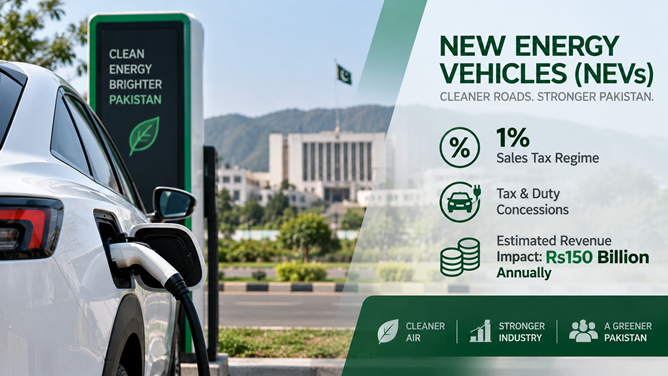
Pakistan’s favourable tax and duty treatment for New Energy Vehicles (NEVs) could result in around Rs150 billion in annual revenue concessions, according to an estimate by a former chairman of the Pakistan Association of Automotive Parts and Accessories Manufacturers (PAPAAM).
The estimate has brought renewed attention to the fiscal cost of tax incentives offered to encourage Pakistan’s transition towards electric and other new-energy vehicles.
NEVs currently receive favourable tax and duty treatment, including a 1% sales tax regime, according to a report published on September 8.
How Is the Rs150 Billion Figure Calculated?
Former PAPAAM chairman Abdul Rehman estimated that annual NEV sales in Pakistan could reach around 50,000 vehicles.
He estimated the average reduction in duties and taxes at approximately Rs3 million per vehicle.
Based on those assumptions:
50,000 vehicles × Rs3 million = Rs150 billion
This means the Rs150 billion figure represents an estimate of potential annual revenue forgone through the concessions. It should not be interpreted as an official FBR calculation of actual tax revenue already lost.
NEVs Receive Favourable Tax Treatment
Pakistan has been encouraging the adoption of New Energy Vehicles as part of its wider transition towards cleaner transportation.
The Ministry of Industries and Production lists the New Energy Vehicles Policy 2025-30 among Pakistan’s current industrial policies.
Tax and duty concessions are intended to make these vehicles more attractive to consumers and encourage investment in the emerging NEV industry.
The current debate is not simply about whether electric and new-energy vehicles should receive incentives. It is also about the size and distribution of those incentives.
Why Is the 1% Sales Tax Significant?
A lower sales tax can substantially reduce the tax burden on a vehicle compared with a higher standard rate.
For buyers, this can reduce the final cost of purchasing an eligible vehicle.
For the government, however, every concession also means revenue that might otherwise have been collected.
The fiscal impact becomes much larger as NEV sales increase.
This is why an estimated 50,000 annual vehicle sales combined with significant tax and duty concessions could potentially produce a very large revenue impact.
Questions Raised Over Rs150 Billion Tax Concession
Abdul Rehman questioned whether such a large potential fiscal concession represents the best use of government support for electric mobility.
He argued that Pakistan does need to move towards cleaner transportation.
Electric and new-energy vehicles could help the country reduce fuel consumption, lower emissions and develop a domestic EV industry.
The question, however, is whether incentives should primarily support private vehicle purchases or whether more resources should go towards mass-market electric transport.
Could Tax Incentives Be Targeted Differently?
The debate raises several alternatives for government support.
Instead of concentrating incentives on private vehicles, public resources could potentially support:
- Electric buses
- Electric motorcycles
- Electric rickshaws
- EV charging infrastructure
- Local battery manufacturing
- Local vehicle components
- Public transport electrification
Such measures could potentially spread the benefits of Pakistan’s transition to electric mobility across a larger section of the population.
Pakistan Already Has an NEV Policy
Pakistan’s New Energy Vehicles Policy 2025-30 provides the broader policy framework for the country’s shift towards new-energy transportation.
The government’s objective isn’t limited to increasing vehicle sales. The transition also involves local manufacturing, charging infrastructure, reducing dependence on imported fuels and developing the wider EV ecosystem.
Tax policy therefore plays an important role in determining how quickly that transition takes place and which parts of the market receive the greatest benefit.
Are NEV Tax Incentives Good or Bad for Pakistan?
There isn’t a simple answer.
Lower taxes can encourage consumers to switch to cleaner vehicles and can help a relatively young industry grow.
They can also attract manufacturers and encourage local investment.
However, tax concessions have a fiscal cost.
Pakistan therefore has to balance the benefits of accelerating NEV adoption against the revenue the government gives up through preferential tax treatment.
The key policy question is whether the economic, environmental and industrial benefits generated by these concessions justify their cost.
TaxToday.pk Note
The reported Rs150 billion annual figure is an estimate, based on projected sales of around 50,000 NEVs and an estimated average tax and duty concession of Rs3 million per vehicle.
It is not an announcement that FBR has already lost Rs150 billion in tax revenue.
This distinction is important for taxpayers and readers assessing the fiscal impact of Pakistan’s NEV policy.
As NEV sales increase, the tax treatment of electric and other new-energy vehicles is likely to remain an important part of Pakistan’s wider tax and industrial policy debate.
TaxToday.pk will continue monitoring changes in sales tax, customs duties and other taxes affecting Pakistan’s automobile and NEV sectors.