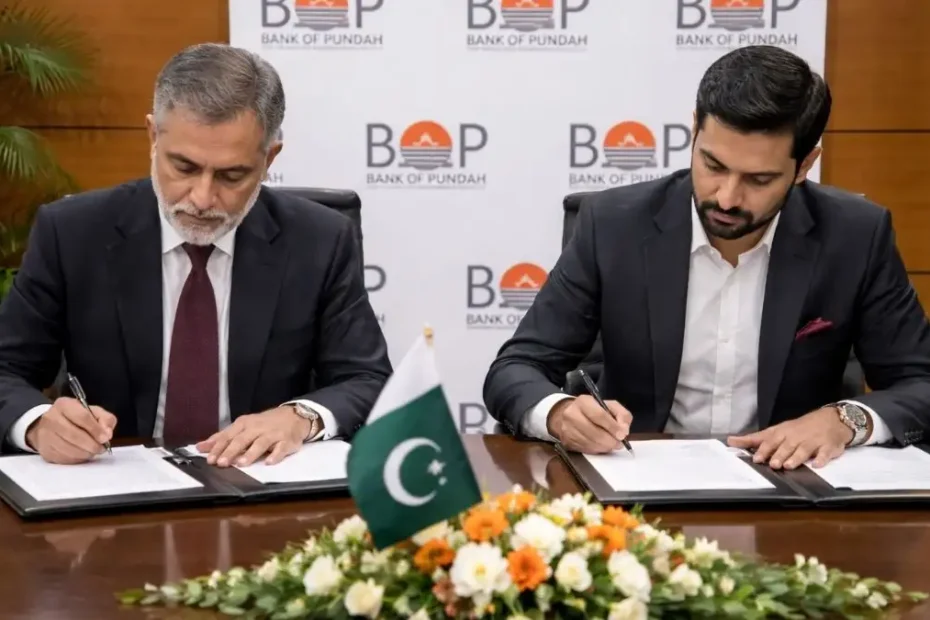
The Bank of Punjab (BOP) and the Punjab Office of Artificial Intelligence signed a Memorandum of Understanding on Friday, committing to build a Punjab AI Data Centre and Financial Data Warehouse at Nawaz Sharif IT City in Lahore — the institutional foundation for AI-powered loan products targeting farmers, small businesses, and housing borrowers across Pakistan’s most populous province.
The deal, led by Punjab Chief Minister’s Adviser on AI Ali Dar, positions BOP as the primary banking infrastructure partner for CM Maryam Nawaz’s target of making Punjab the largest AI-enabled province in South Asia by 2029.
Under the agreement, modern loan facilities will be introduced for farmers, small businesses, and the housing sector. AI will help deliver financial services more efficiently to the general public, while improving access to loans for low-income individuals. The initiative will create over 100,000 employment opportunities and open new avenues in technology for youth. The partnership will also encourage collaboration with startups, universities, and global AI companies.
The MoU establishes four operational pillars:
| Pillar | Detail |
|---|---|
| Infrastructure | Punjab AI Data Centre + Financial Data Warehouse at Nawaz Sharif IT City |
| Credit Products | AI-powered loans for farmers, SMEs, and housing sector |
| Employment Target | 100,000+ jobs over 3 years |
| Ecosystem | Collaboration with startups, universities, and global AI firms |
Ali Dar stated that a Punjab AI Data Centre and Financial Data Warehouse will be established in the Nawaz Sharif IT City, forming the backbone of advanced data systems. The government aims to make Punjab the largest AI-enabled province in South Asia by 2029, with strong data systems under development.
Ali Mustafa Dar serves as Adviser to Punjab Chief Minister Maryam Nawaz Sharif on Artificial Intelligence and Special Initiatives, with the powers of a provincial cabinet minister. He holds a software engineering degree from University College London and UMIST, and has publicly stated his ambition to make Punjab the most AI-enabled province in South Asia. He is the son of Deputy Prime Minister and Foreign Minister Ishaq Dar and son-in-law of former Prime Minister Nawaz Sharif.
The BOP-AI Office MoU is the latest step in a roadmap Ali Dar presented to CM Maryam Nawaz in March 2026. That Punjab AI Roadmap set a target of transforming Punjab into South Asia’s leading AI-driven region by 2029, creating over 100,000 jobs and enhancing governance. The world’s first AI Delivery Unit is to be established in Punjab, with the chief minister serving as chairperson.
BOP is the natural institutional partner for an AI-powered financial inclusion push. By adopting AI-powered credit scoring and machine learning models, BOP has been able to offer unsecured loans at scale, reducing reliance on manual intervention and accelerating approvals. BOP’s Kissan Card, designed for small farmers, has already provided loans to over 710,000 farmers, many of whom are accessing credit for the first time.
BOP’s strategy centres on two key sectors: SMEs and agriculture. With nearly 65% of Pakistan’s GDP driven by the combined contribution of the agriculture and SME sectors, the bank has tailored products like the Livestock Card and Asaan Karobar Card to meet the specific needs of small businesses and farmers.
The Asaan Karobar Card is Pakistan’s largest SME credit card lending programme by volume. Kissan Card disbursements stood at Rs 54 billion across 535,000 cards as of October 2025, making BOP the dominant agricultural lender in Punjab’s provincial banking ecosystem. The AI Office MoU now formally integrates these existing credit pipelines into a centralised data architecture — potentially enabling automated credit scoring, fraud detection, and real-time subsidy disbursement at provincial scale.
Establishing the Punjab AI Data Centre at Nawaz Sharif IT City is strategically significant for two reasons. First, it consolidates Punjab’s AI computing infrastructure within a single facility — giving BOP, government departments, and partner startups shared access to sovereign AI infrastructure without routing sensitive financial data through offshore servers. Second, according to the Punjab AI Roadmap, the province’s GDP is expected to increase by 5 to 10% and foreign exchange reserves may grow by $10 to $20 billion as a result of AI-led economic activity.
These projections remain aspirational rather than independently verified, but they signal the political weight that CM Maryam Nawaz’s administration attaches to the initiative — and the scale of fiscal resources BOP may eventually route through AI-enabled channels.
BOP operates under SBP regulation. The SBP policy rate currently stands at 10.5% — held at its March 9, 2026 MPC meeting — making conventional bank lending still expensive for small borrowers. AI-powered credit scoring reduces the cost of loan origination and default prediction, which in theory allows banks to lend profitably at lower effective rates to segments — smallholder farmers, micro-SMEs, first-time housing borrowers — that conventional underwriting cannot serve at scale. This is the structural opportunity the BOP-AI Office MoU targets.
For Pakistan’s 1.5 million smallholder farmers in Punjab, for the millions of SMEs currently excluded from formal credit, and for the estimated 10 million housing-deficit households the Apni Chhat Apna Ghar scheme is attempting to serve, AI-enabled lending at BOP means faster approvals, lower documentation barriers, and credit access without the collateral requirements that have historically excluded the informal economy from the banking system.
BOP (PSX: BOP) is a listed provincial commercial bank, majority-owned by the Government of Punjab, and the primary banking partner for CM Maryam Nawaz’s flagship welfare programmes including Kissan Card, Asaan Karobar Card, and Apni Chhat Apna Ghar. The Punjab Office of AI was established in February 2026 under Ali Dar’s appointment. Pakistan’s national AI investment target stands at $1 billion by 2030, announced by PM Shehbaz Sharif at the Indus AI Week 2026 inauguration on February 9, 2026.