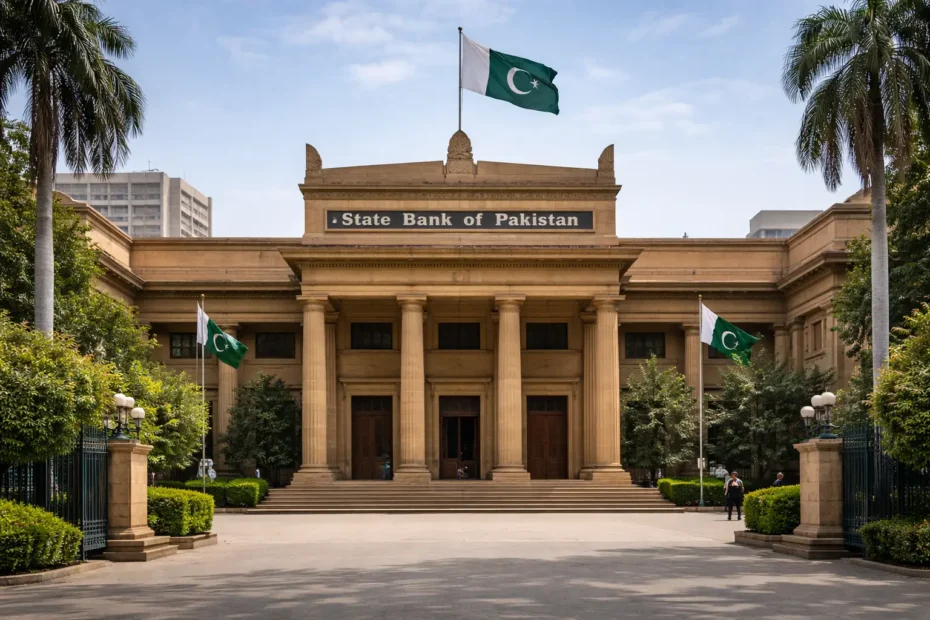
The State Bank of Pakistan’s foreign exchange reserves gained $6 million in the week ending 27 March 2026, reaching $16.382 billion, as the central bank’s weekly statistical release published on Thursday showed. Pakistan’s total liquid foreign reserves — combining SBP holdings with commercial bank balances — climbed $54 million week-on-week to $21.79 billion.
SBP’s foreign exchange reserves increased by $5.9 million, or 0.04% week-on-week, to $16.38 billion during the week ended 27 March 2026, according to data released by the State Bank of Pakistan.
Commercial bank net foreign reserves stood at $5.408 billion, an increase of $48 million on a weekly basis, bringing total liquid foreign exchange reserves to $21.79 billion.
| Reserve Category | 27 March 2026 | Previous Week | Weekly Change |
| SBP-held reserves | $16.382 billion | $16.376 billion | +$6 million |
| Commercial bank reserves | $5.408 billion | $5.360 billion | +$48 million |
| Total liquid reserves | $21.79 billion | $21.73 billion | +$54 million |
Source: SBP Weekly Statistical Release, issued 2 April 2026.
The $6 million gain in SBP’s own holdings — just 0.04% — represents the smallest weekly increment in several months and signals a slowdown in the central bank’s reserve-building pace. In the weeks before 27 March, SBP reserves had posted gains of $22 million, $13 million, and $41 million in successive weeks.
The more significant movement came from commercial banks, whose $48 million addition drove the bulk of the total $54 million weekly increase — a pattern that reflects continued dollar inflows through trade finance and remittance channels rather than fresh sovereign borrowing or official bilateral deposits.
SBP’s $18 Billion Target — Where Pakistan Stands
The SBP had earlier confirmed that its reserves target of $18 billion would be met by end-FY26 — June 2026. At $16.382 billion, the central bank sits roughly $1.62 billion short of that milestone with two months remaining in the fiscal year.
SBP’s FX reserves were expected to surpass $18 billion by June 2026 and rise further in FY2027, nearing the 3-month import cover benchmark. Analysts, however, have flagged the geopolitical risk to that trajectory.
The Iran War Pressure on Pakistan’s External Account
Pakistan’s reserve-building faces a direct headwind from rising import costs. The State Bank of Pakistan kept its benchmark policy rate unchanged at 10.5% in March, citing heightened economic uncertainty as oil prices surged amid escalating tensions in the Middle East. Pakistan remains particularly vulnerable to rising energy costs due to its heavy reliance on imported fuel.
Headline inflation reached 7% in February 2026, the highest since October 2024, and analysts warn the recent Rs 55/litre fuel price increase — the largest single hike on record — could push inflation to around 9.25% in the second quarter.
A wider current account deficit, driven by a heavier oil import bill, could slow the pace of SBP’s reserve accumulation in the April–June quarter, making the $18 billion June target progressively harder to reach.
The SBP’s weekly statistical release stated directly: “During the week ended on 27-Mar-2026, SBP’s FX reserves increased by US$ 6 million to US$ 16,381.7 million.”At the March 2026 MPC meeting, the Monetary Policy Committee assessed that external pressures from the ongoing US-Israel-Iran conflict had made the macroeconomic outlook “quite uncertain” and opted to hold the policy rate at 10.5% — signalling the SBP’s priority remains inflation containment and reserve preservation over further monetary easing.
Pakistan’s reserve buffer at $21.79 billion total provides roughly 2.5 months of import cover — below the internationally recommended 3-month floor. Every dollar of reserve erosion from a higher oil import bill directly weakens the rupee’s stability, threatens the IMF programme’s external targets, and keeps borrowing costs elevated for businesses and consumers. With the SBP policy rate locked at 10.5% and fuel prices at historic highs, businesses relying on imported inputs and salaried workers alike face sustained cost pressure through at least the first half of the April–June quarter.