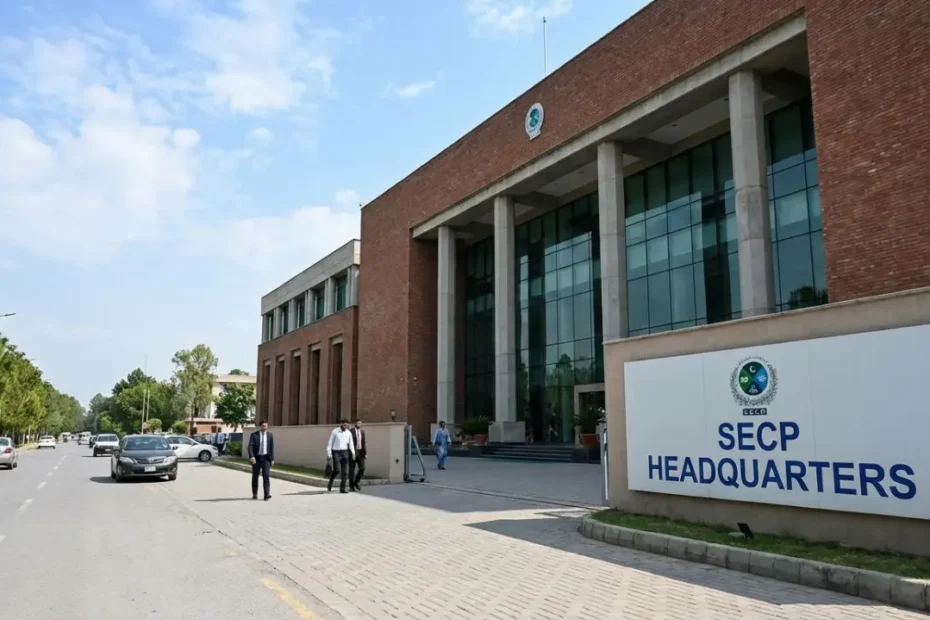
PM Shehbaz Forms High-Level Committee to Reform SECP and Clear 2,000 Pending Corporate Cases
Prime Minister Shehbaz Sharif formed a high-level committee on April 1, 2026 to implement structural reforms at the Securities and Exchange Commission of Pakistan, with the twin mandate of expanding SECP’s enforcement powers and clearing a court backlog of over 2,000 pending corporate cases. The committee held its inaugural meeting under Federal Law Minister Azam Nazir Tarrar, with SECP Chairman Dr Kabir Ahmed Sidhu presenting the scale of the crisis and an early reform framework.
What the Committee Is Tasked With
The Prime Minister established the high-level committee with the goal of giving SECP more power and clearing 2,000 pending corporate cases, with the first meeting chaired by Federal Law Minister Azam Nazir Tarrar and focused on empowering SECP and making its enforcement regime more effective.
SECP Chairman Dr Kabir Sidhu, presenting at the first meeting, highlighted that over 2,000 cases are currently pending in courts and emphasised that reforms are urgently needed to ensure swift resolution of these cases and to enable SECP to recover fines efficiently.
Law Minister Tarrar, chairing the session, confirmed the government’s commitment to legislative action. Tarrar stressed that necessary legislation would be introduced to fully empower SECP, and requested that SECP provide complete data on pending cases and present a comprehensive reform plan at the next committee meeting.
Special Tribunals and Digital Fraud Prevention Proposed
Dr Sidhu also proposed the establishment of special tribunals to handle SECP-related cases and the digitalisation of the regulatory framework to prevent corporate fraud.
The special tribunal proposal addresses a structural bottleneck that has paralysed SECP enforcement for years — corporate cases filed by the regulator sit in regular civil courts alongside thousands of other commercial disputes, creating a queue that ordinary judicial capacity cannot clear at pace. Dedicated SECP tribunals, modelled on similar mechanisms in tax and banking law, would give the regulator a dedicated judicial forum with faster disposal timelines.
Dr Sidhu’s Track Record — The Benchmark He Brings
PM Shehbaz appointed Dr Kabir Ahmed Sidhu as SECP Chairman in January 2026, moving him from the Competition Commission of Pakistan where he had built a strong enforcement record. At the CCP, within two years, Dr Sidhu reduced the court case backlog by over 70% — with 434 cases decided out of 567 pending matters — helping restore the regulator’s credibility and enforcement capacity. During his tenure, CCP recovered approximately Rs 1.36 billion in penalties, compared to total recoveries of merely Rs 200 million across the previous 20 years. The regulator also imposed over Rs 2 billion in fresh penalties through new enforcement actions.
The appointment — and now this committee — signals that the government intends to replicate the CCP turnaround model at SECP, where the enforcement gap is far larger and the listed company and capital market stakes considerably higher.
IMF Governance Diagnostic — The Pressure Behind This Move
This committee does not exist in a vacuum. Pakistan’s $7 billion IMF Extended Fund Facility carries explicit SECP-related governance conditions. The IMF’s Governance and Corruption Diagnostic Assessment, published in November 2025, specifically called on Pakistan to initiate actions to reduce the backlog of economic disputes and to review the legal framework governing the appointment of heads of key oversight bodies, including the SECP, to promote merit-based, transparent, and credible selection processes.
The government’s 142-point governance action plan, launched by PM Shehbaz in January 2026 in response to the IMF’s Governance and Corruption Diagnostic report, commits to notifying SECP rules codifying the appointment process for its chairman, commissioners, and policy board members by June 2027.
The April 1 committee formation translates that paper commitment into an active institutional mechanism — with a named minister, a named chairman, and a first meeting already on record.
What This Means for Listed Companies and Investors
| Reform Area | Current Status | Proposed Change |
|---|---|---|
| Court Backlog | 2,000+ cases pending | Special dedicated SECP tribunals |
| Fine Recovery | Severely constrained | Legislative strengthening of enforcement |
| Corporate Fraud | Manual detection | Digitalisation of regulatory framework |
| Governance Rules | Discretionary | Codified appointment process by June 2027 |
For PSX-listed companies and their shareholders, SECP’s enforcement paralysis has carried a direct market cost — cases involving corporate fraud, related-party transaction violations, and disclosure breaches have stalled in courts for years without resolution, reducing deterrence and undermining investor confidence in Pakistan’s equity market. A reformed SECP with special tribunal powers and digital fraud detection would represent the most significant upgrade to Pakistan’s corporate enforcement architecture since the SECP Act was last substantially amended. For foreign institutional investors — a constituency the SIFC has been actively courting — an effective SECP is a precondition for sustained capital market engagement.