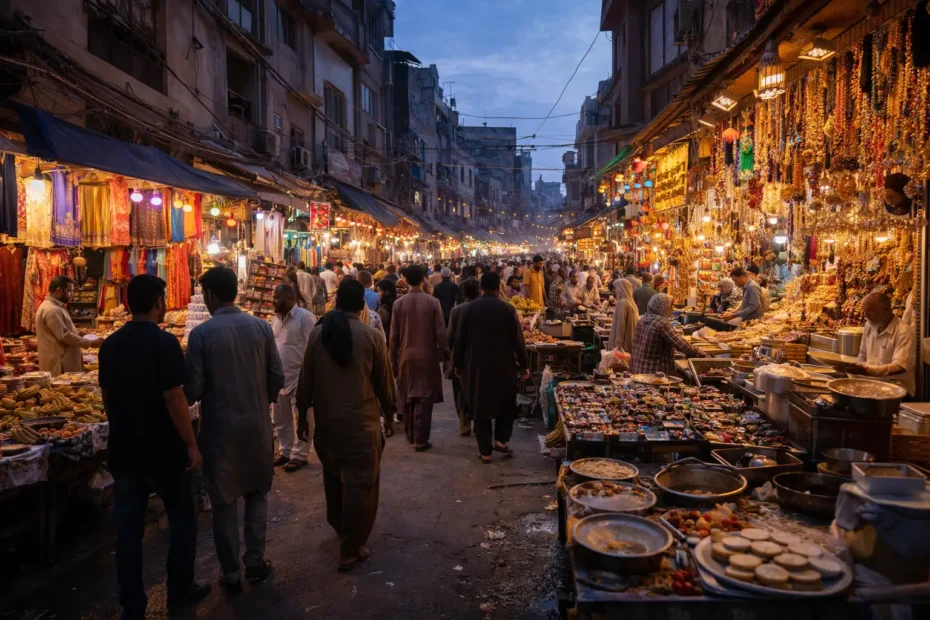
Prime Minister Shehbaz Sharif chaired a high-level meeting on Monday on petroleum product conservation, energy efficiency, and austerity implementation — ordering all markets, shopping malls, and commercial outlets across Punjab, KP, Balochistan, Islamabad, Gilgit-Baltistan, and AJK to close by 8PM effective Tuesday 7 April 2026, as Pakistan deepens its fuel crisis response. Sindh remains the only province yet to align, with the PM Office stating consultation with stakeholders is ongoing.
Markets, shopping malls, and commercial centers in Punjab, Khyber Pakhtunkhwa, Balochistan, Islamabad Capital Territory, Gilgit-Baltistan, and Azad Jammu & Kashmir will close by 8PM from April 7. For KP, divisional headquarters markets and malls may remain open until 9PM in consultation with the provincial government. Essential goods stores, departmental stores, and all retail outlets follow the 8PM closure rule. Bakeries, restaurants, tandoors, and food outlets close by 10PM. Marriage halls, marketplaces, and commercial venues hosting weddings also close by 10PM.
Wedding events held in private properties and homes are also prohibited after 10PM. Medical stores and pharmacies are exempt from these restrictions.
| Venue Type | Punjab / Balochistan / ICT / GB / AJK | KP Divisional HQs |
|---|---|---|
| Markets, malls, departmental stores | Close at 8PM | Close at 9PM |
| Bakeries, restaurants, tandoors, food outlets | Close at 10PM | Close at 10PM |
| Wedding halls and marquees | Close at 10PM | Close at 10PM |
| Private wedding events | End by 10PM | End by 10PM |
| Medical stores / pharmacies | Exempt | Exempt |
Source: PM Office official statement, 7 April 2026.
PM Sharif said: “I hope that the Chief Minister of Sindh will also join this decision after completing the consultation process soon.” Sindh’s market timings remain under discussion.
Sindh’s absence from the first-day implementation creates an uneven enforcement landscape — particularly relevant for Karachi, Pakistan’s commercial capital and largest retail market, which remains open under its existing schedule until the provincial government concludes its stakeholder consultations.
The 8PM closure builds on a layered austerity programme that the federal and provincial governments have progressively tightened since the fuel crisis began on 28 February 2026:
The austerity drive includes a 20% cut in non-salary government expenditure and a ban on purchasing new vehicles and equipment. The federal cabinet has foregone salaries for two months and MPs took a 25% pay cut. 50% of staff work from home on a rotating basis. Critical services — ambulances, public buses, hospitals — are exempt from fuel quota cuts.
Additionally, as part of a subsidy initiative for petroleum products, the federal government has completed over 100,000 digital subsidy transactions. Intercity public transport in Gilgit and Muzaffarabad will be free for one month, with the federal government bearing all costs.
Punjab has made all public transport free, including the Orange Line Train and Metro Bus services, and is offering direct fuel subsidies to farmers and motorcyclists. Sindh has announced a Rs 2,000 subsidy for registered motorcyclists and substantial monthly financial assistance for transporters, with intra-city buses eligible for up to Rs 1.2 million per month.
KP and Balochistan are enforcing market closures and banning non-essential lighting and commercial generator use. In Balochistan, pharmacies, bakeries, and tandoors are specifically exempted from the 8PM closure under a notification from the Balochistan Home Department.
The prime minister praised the cooperation of provincial governments in reaching a consensus on energy-saving measures, describing the steps as vital for national economic stability.
The meeting was attended by Deputy PM and Foreign Minister Ishaq Dar, Federal Minister for Economic Affairs Ahad Khan Cheema, and other senior officials who reviewed progress on the broader austerity programme.
An 8PM market closure directive directly hits Pakistan’s retail sector, which generates its peak footfall between 7PM and 10PM — particularly in the post-Eid shopping season and during Ramadan-adjacent periods. Small retailers, clothing shops, electronics stores, and food stalls in bazaars across Punjab, KP, and Balochistan must now close two to four hours earlier than their typical schedules. For consumers, the closure compresses the buying window and drives shopping earlier in the day — shifting electricity consumption from the 8PM–midnight peak load period when power demand typically spikes.
For Pakistan’s government, the measure aims to save an estimated 1,200 megawatts of peak electricity demand daily, directly reducing diesel-fired backup generation costs at a time when diesel stands at Rs 520.35 per litre.