Global oil markets recorded their sharpest single-day collapse since the 1991 Gulf War on Wednesday after Pakistan brokered a two-week ceasefire between the United States and Iran, with Iran agreeing to permit safe maritime passage through the Strait of Hormuz — the waterway whose effective closure since early March 2026 had triggered the worst oil supply shock in recorded history. Brent crude futures fell nearly 16% from $109.27 to $91.72 per barrel, while WTI dropped 15% to approximately $95 per barrel, erasing weeks of war-premium pricing within hours.
Global oil markets witnessed a sharp sell-off of over 15% on Wednesday after the United States and Iran agreed to a temporary two-week ceasefire, with Pakistan mediating the much-anticipated talks. The dramatic decline followed diplomatic progress achieved by Pakistan to convince both Washington and Tehran to halt the war for two weeks.
The president agreed to the ceasefire after discussions with Pakistan Prime Minister Shehbaz Sharif. Sharif had asked Trump to delay his deadline to allow negotiations to continue, and also asked Iran to reopen the Strait during that period as a goodwill measure.
Iran’s Foreign Minister Seyed Abbas Araghchi announced that Tehran would permit safe maritime passage through the strategically vital Strait of Hormuz for the next two weeks. US President Donald Trump confirmed via social media that Washington would suspend bombing against Iran during the ceasefire period. He described the arrangement as a “double-sided ceasefire,” saying military objectives had largely been achieved and both sides were nearing a broader agreement aimed at long-term regional peace.
Trump said: “We received a 10-point proposal from Iran, and believe it is a workable basis on which to negotiate.” The agreement came less than two hours before his 8pm ET deadline.
It is the biggest one-day free fall in oil prices since the 1991 Gulf War. The global benchmark Brent crude futures price fell about 13% to about $95 a barrel — though still far above the roughly $73 mark right before the war began at the end of February. WTI, the US benchmark, fell to about $96 a barrel, a drop of about 14%.
| Benchmark | Pre-War (27 Feb) | War Peak | Post-Ceasefire (8 Apr) | One-Day Change |
|---|---|---|---|---|
| Brent Crude | ~$73/barrel | ~$126/barrel | $91.72/barrel | −15.6% |
| WTI Crude | ~$67/barrel | ~$117/barrel | ~$95/barrel | −15.0% |
Source: CNBC, Bloomberg, ProPakistani, 8 April 2026.
S&P 500 futures soared, rising more than 2.5%, while Dow futures spiked by 1,000 points and Nasdaq 100 futures jumped nearly 3%. US Treasury yields also declined on the announcement. Spot gold prices jumped 2.5%, and silver rose 4.6%. Markets in Asia and Europe were set to open sharply higher. Futures contracts for Japan’s Nikkei benchmark stock index pointed to a jump of nearly 3% when it opens.
Pakistan’s own KSE-100 closed at 151,673.46 on Tuesday — up 465.64 points — as ceasefire optimism filtered into equities ahead of the formal announcement. Wednesday’s session opened sharply higher on the confirmed ceasefire news.
Analysts issued immediate warnings against assuming a full supply normalisation.
The key question now is whether physical shipping traffic actually resumes through the Strait of Hormuz. Without that, the crude oil premium will rebuild and the dollar’s safe-haven bid will return. Trump’s fourth deadline extension since the conflict began in late February means traders had been positioning for exactly this outcome throughout the session.
Iran claimed victory and said its military will regulate passage through the Strait of Hormuz, which would grant Iran “unique economic and geopolitical standing.” Iran’s insistence on regulating — rather than simply reopening — Hormuz passage means the physical oil flow situation remains uncertain until tankers actually start moving.
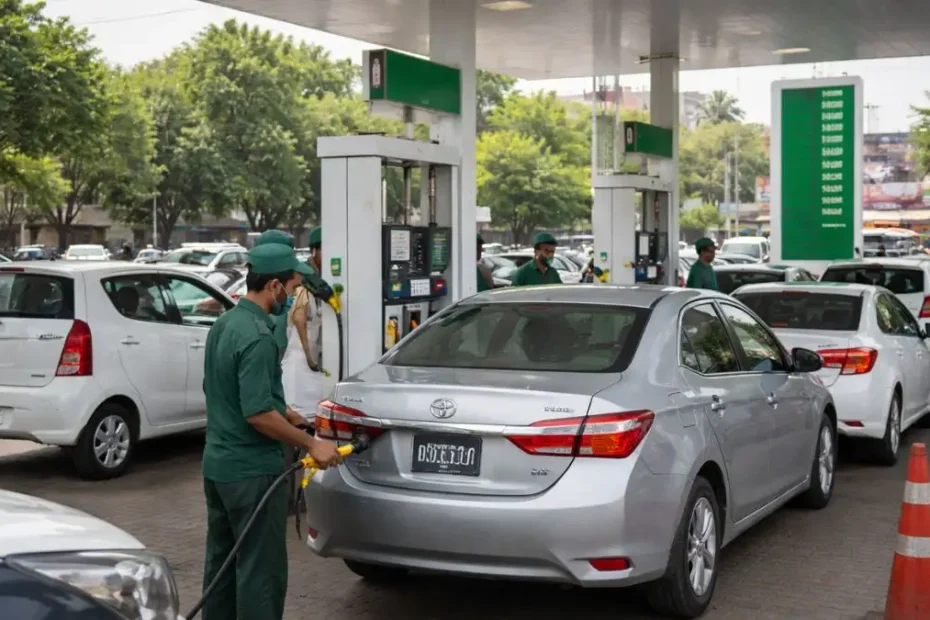
Pakistan stands as one of the most directly affected countries globally from the Strait of Hormuz disruption, importing approximately 80% of its energy from Gulf sources. The current domestic fuel prices — petrol at Rs 378 per litre (after PM Shehbaz’s Rs 80 petroleum levy cut on 4 April) and diesel at Rs 520.35 per litre — were set when Brent crude traded above $100 per barrel. Every $1 change in Brent crude equals approximately Rs 1.50–2.00 per litre at the pump for Pakistani consumers.
With Brent now trading near $92–$95, the directional pressure on Pakistan’s next OGRA fortnightly review — due around 16 April 2026 — shifts from upward to potentially downward, provided the ceasefire holds and the rupee remains stable at approximately Rs 279–280 per dollar. A sustained $15/barrel decline in Brent could translate to Rs 22–30 per litre reduction in the OGRA-calculated ex-refinery cost before government taxes.
Pakistan’s petroleum levy currently stands at Rs 80 per litre on petrol (reduced from Rs 160 during the crisis), giving the Finance Ministry room to either pass crude cost savings through to consumers or rebuild levy revenue under IMF programme requirements.
Pakistan’s army chief, Field Marshal Asim Munir, was in contact “all night long” with US Vice President JD Vance, special envoy Steve Witkoff, and Iranian Foreign Minister Abbas Araqchi, working to propose an immediate ceasefire followed by a broader 15–20 day settlement window.
PM Shehbaz Sharif’s role as the direct interlocutor with President Trump — asking Trump to delay his deadline to allow negotiations to continue, and separately asking Iran to reopen the Strait as a goodwill measure — elevated Pakistan to an unprecedented mediating position between two nuclear-armed adversaries in an active conflict that had triggered a global energy crisis.