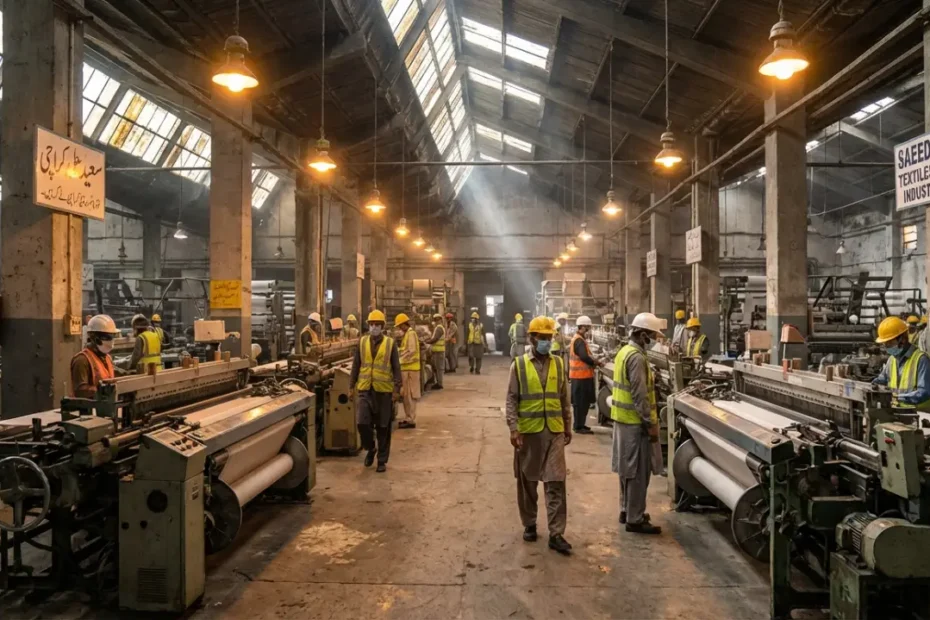
HBL PMI: Pakistan Factory Growth Slows in March as Iran War Pushes Selling Prices to 19-Month High
Pakistan’s manufacturing sector expanded at a weaker pace in March 2026 as the Middle East conflict drove input costs sharply higher, pushing selling price inflation to a 19-month peak, according to the HBL Pakistan Manufacturing PMI compiled by S&P Global and released on April 2. Business optimism among Pakistani manufacturers fell again — mirroring a broad Asia-wide factory slowdown recorded across the same survey cycle.
What the March PMI Shows
The S&P Global PMI page for the March 2026 release carries the headline: “Selling price inflation reaches 19-month high, while business optimism wanes again.”
The March 2026 reading follows a strong February surge. Pakistan’s manufacturing sector had gained significant momentum in February, with the HBL Pakistan Manufacturing PMI rising to 53.6 from 51.8 in January — the highest reading in a year — driven by the strongest increase in new orders in 11 months and a return to export order growth.
The March pullback from that 53.6 peak — driven by soaring energy and raw material costs linked to the Iran war — confirms that the sector’s recovery trajectory has entered a new phase of cost-driven pressure, even as headline output remains above the 50.0 expansion threshold.
| Month | PMI Reading | Key Signal |
|---|---|---|
| January 2026 | 51.8 | Slowest growth in 3 months; confidence at series low |
| February 2026 | 53.6 | One-year high; export orders return to growth |
| March 2026 | Released Apr 2 | Selling prices 19-month high; optimism wanes again |
Selling Prices: The Iran War Cost Transmission in Real Time
Cost pressures had already intensified in February, with input prices rising at their quickest pace since January 2025, driven by higher raw material costs. In response, manufacturers raised selling prices at the highest rate in 18 months to safeguard margins and pass through both tax and cost-related increases.
March’s data shows that cost pressure accelerated further — selling price inflation pushed to a 19-month high, the steepest pass-through recorded since the index launched in May 2024. The Iran war’s disruption of Strait of Hormuz shipping routes and the resulting spike in global oil and coal prices fed directly into Pakistani manufacturers’ energy and transportation cost lines during March’s survey window.
Many Asian economies saw factory activity slow in March as surging fuel costs and heightening global uncertainty from the Iran war took a toll on the region.Pakistan’s experience — selling price inflation at a 19-month high — aligns with regional peers: Japanese factory input prices rose at the fastest rate since August 2024, while Indonesia’s PMI fell to 50.1 from 53.8 in February and Vietnam’s slowed to 51.2 from 54.3.
Business Optimism Wanes — A Recurring Concern
The March report marks at least the second consecutive month in which business confidence deteriorated. In January 2026, the degree of optimism among Pakistani manufacturers eased to the lowest in the 21-month series history, with firms citing potential headwinds from higher tariffs, inflationary pressures, and a subdued domestic economy.
Commenting on the February reading — the last formally attributed quote available — Kumail Chevelwalla, Team Lead Equities & Research at HBL Bank, noted: “The recent firming in inflation expectations is becoming increasingly evident.” He added: “While Pakistani firms remain broadly optimistic regarding output growth over the next year, confidence has fallen to a record low, as respondents continued to highlight tariff-related pressures and an elevated tax burden.”
Pakistan in Regional Context
Pakistan’s manufacturing PMI slowdown in March sits within a deteriorating Asia-wide picture driven by the same shock. The RatingDog China General Manufacturing PMI fell to 50.8 in March from 52.1, missing analysts’ forecast of 51.6. The final S&P Global Japan Manufacturing PMI fell to 51.6 from 53.0, with input prices rising at the fastest rate since August 2024.
South Korea was an outlier, with factory activity expanding at the strongest pace in more than four years, led by semiconductor demand and new product launches.Pakistan, as an energy-import-dependent manufacturing economy with no significant semiconductor export exposure, sits at the more vulnerable end of the regional spectrum.
What This Means for Pakistani Manufacturers and the SBP
For Pakistani manufacturers — particularly in textiles, food processing, and chemicals, which dominate the PMI panel — March’s selling price spike confirms a margin squeeze is underway. Input costs rose faster than manufacturers could fully pass through in earlier months; in March, the pass-through finally accelerated to a 19-month high. That means consumer prices for manufactured goods will track higher into April and May — adding fuel to the 7.3% CPI reading already recorded for March 2026, which breached the SBP’s 5–7% target band for the first time since August 2024.
For the SBP’s Monetary Policy Committee — which next meets in May 2026 — the March PMI data creates a dilemma. The manufacturing sector still sits above 50.0, indicating growth, but the combination of cost-driven selling price inflation and falling business optimism suggests that any further rate cuts risk amplifying price pressures without meaningfully boosting demand. The SBP currently holds its policy rate at 12%, following a series of cuts from the 22% peak of FY2023–24.
The HBL Pakistan Manufacturing PMI, compiled monthly by S&P Global from a panel of approximately 300 manufacturers, launched in May 2024 as Pakistan’s first standardised manufacturing activity index. The index was designed as a key economic indicator for financial institutions, policymakers, and businesses in a country where high-frequency economic data has historically been scarce. It releases on the first working day of each month. A reading above 50.0 signals expansion; below 50.0 signals contraction.