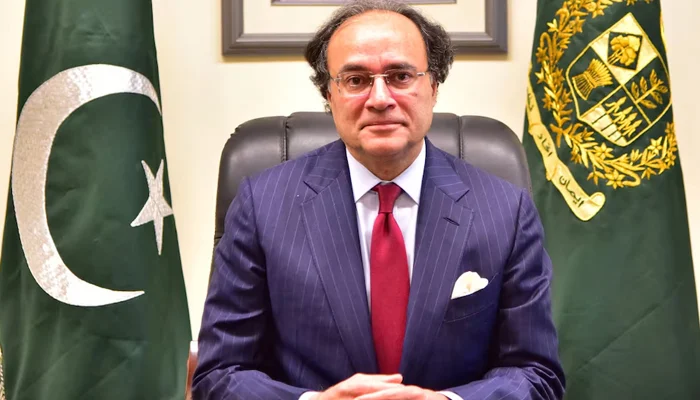
Finance Minister Muhammad Aurangzeb told Reuters on the sidelines of the IMF/World Bank Spring Meetings in Washington on Monday that Pakistan has placed every financing instrument on the table — Eurobonds, Islamic sukuk, dollar-settled rupee-linked bonds, commercial loans, and a potential expanded IMF programme — as the country works to replace a $3.5 billion UAE facility it is repaying this month after Abu Dhabi refused a rollover for the first time in seven years. With SBP reserves at $16.4 billion against the IMF’s $18 billion June target, and total April repayments hitting approximately $4.8 billion, Pakistan faces its most compressed external financing challenge since the 2023 near-default.
Pakistan will repay $450 million during the current week, followed by two larger tranches of $2 billion on April 17 and $1 billion on April 23. The loans, some dating back to the late 1990s and rolled over multiple times, carry an interest rate of around 6.5%.
The $3.5 billion UAE repayment follows Pakistan’s April 7 settlement of a $1.43 billion Eurobond. Combined, Pakistan is executing approximately $4.8 billion in external repayments within a single month — the largest single-month outflow in Pakistan’s reserve management history. Central bank reserves currently stand at around $16.4 billion, meaning the UAE loan — equivalent to roughly 18% of holdings — represents a significant near-term drain if not replaced. The IMF programme requires foreign exchange reserves above $18 billion by June.
| Repayment | Amount | Date |
|---|---|---|
| UAE tranche 1 | $450 million | April 7–14, 2026 |
| Eurobond | $1.43 billion | April 7, 2026 |
| UAE tranche 2 | $2 billion | April 17, 2026 |
| UAE tranche 3 | $1 billion | April 23, 2026 |
| Total April outflows | ~$4.88 billion | — |
“All options are on the table,” Aurangzeb said when asked if the government was in talks with Saudi Arabia for a loan that could replace the UAE facility. “We are looking at Eurobond, we are looking at Islamic sukuk, we are looking at dollar-settled rupee-linked bonds,” he added, saying Pakistan expected to issue Eurobonds this year and is also exploring commercial loans.
Aurangzeb said while the country had not yet requested any additions or changes to its $7 billion IMF lending programme due to the economic shocks of the war in the Middle East, it was a potential option: “Depending upon how things pan out over the next few weeks, that’s something which can be discussed.”
Aurangzeb said the country could manage all debt repayments, and that its reserves remained at roughly 2.8 months of import cover. Maintaining at least that level, he said, would be “an important aspect of our overall macro stability as we go forward.”
Pakistan is preparing to launch its first Panda bond worth $250 million next month, part of a planned $1 billion programme supported by multilateral institutions including the Asian Development Bank and the Asian Infrastructure Investment Bank. The government also expects strong external inflows, including about $41.5 billion in remittances during the current fiscal year.
The Panda bond — Chinese yuan-denominated debt issued by a foreign borrower in the Chinese domestic market — would be Pakistan’s first foray into the yuan capital market. ADB and AIIB backing significantly reduces investor risk perception and facilitates access for a sovereign still rated speculative grade by global agencies. The $250 million May tranche, if successfully placed, unlocks a further $750 million over subsequent issuances, directly contributing to the reserve rebuilding needed to meet the IMF’s $18 billion June floor.
The Fund’s board is likely to sign off on the latest lending tranche by the end of this month or early next month, Aurangzeb said, which would unlock just under $1.3 billion via the Extended Fund Facility (EFF) and the Resilience and Sustainability Facility (RSF).
Pakistan and the IMF concluded a staff-level agreement on the third review of the $7 billion EFF on March 28, 2026 — after negotiations that shifted online when the IMF mission evacuated from Islamabad mid-review due to the Middle East war escalation. The board meeting, targeting late April or early May, would release approximately $1 billion under EFF and $210 million under RSF, bringing total disbursements under both arrangements to approximately $4.5 billion.
The critical question is what the IMF board expects to see in reserves before it approves — and whether the ongoing UAE repayment drain creates a compliance problem. Aurangzeb’s Washington conversations appear aimed at pre-empting that concern by demonstrating active replacement financing in motion.
Aurangzeb’s statement that an expanded or restructured IMF programme “can be discussed” depending on “how things pan out” is a significant diplomatic signal. Pakistan’s current $7 billion EFF runs through October 2027. A programme adjustment — whether a top-up, a new stand-by arrangement, or modification of performance criteria for energy subsidies and reserve floors in light of the Middle East shock — would require the IMF to acknowledge that Pakistan’s programme assumptions have been materially disrupted by an exogenous geopolitical shock.
The case is strong on the merits. Diesel at Rs 520.35/litre has required Pakistan to spend Rs 129 billion in fuel subsidies over three weeks alone. The PSDP has been cut Rs 100 billion. The petroleum levy was slashed Rs 80/litre. Each of these emergency measures directly violates or strains the fiscal consolidation parameters embedded in the current EFF. Pakistan’s mediator role in the Iran-US ceasefire — brokered April 8 — also provides diplomatic leverage in Washington that FM Aurangzeb is clearly deploying.
Aurangzeb told Reuters the shock from the ongoing war in the Middle East meant that Pakistan must consider a strategic petroleum reserve and a faster switch to renewable energy.
Pakistan currently holds no strategic petroleum reserve — a gap that the Hormuz disruption exposed brutally. With diesel hitting Rs 520.35/litre and petrol Rs 378.41/litre after the levy cut, the cost of not having buffer stocks has been measured in real-time. A strategic reserve would require upfront capital expenditure, storage infrastructure, and a policy framework for drawdown — all of which the government now has incentive to fast-track, particularly if the ceasefire holds and oil prices normalise.
Waqas Ghani, head of research at JS Global Capital, said the UAE repayment represents a significant near-term drain on reserves and could weigh on the rupee, adding that timely support from friendly countries would be critical to stabilising reserves and restoring market confidence.
The KSE-100 had recovered from its April 4 crisis low of 149,129 to 151,673 by April 8 on ceasefire optimism. The reserve trajectory and April 17/23 UAE tranches will be the next critical tests for PSX sentiment — particularly for banking stocks, which are directly linked to sovereign credit standing and IMF programme continuity.