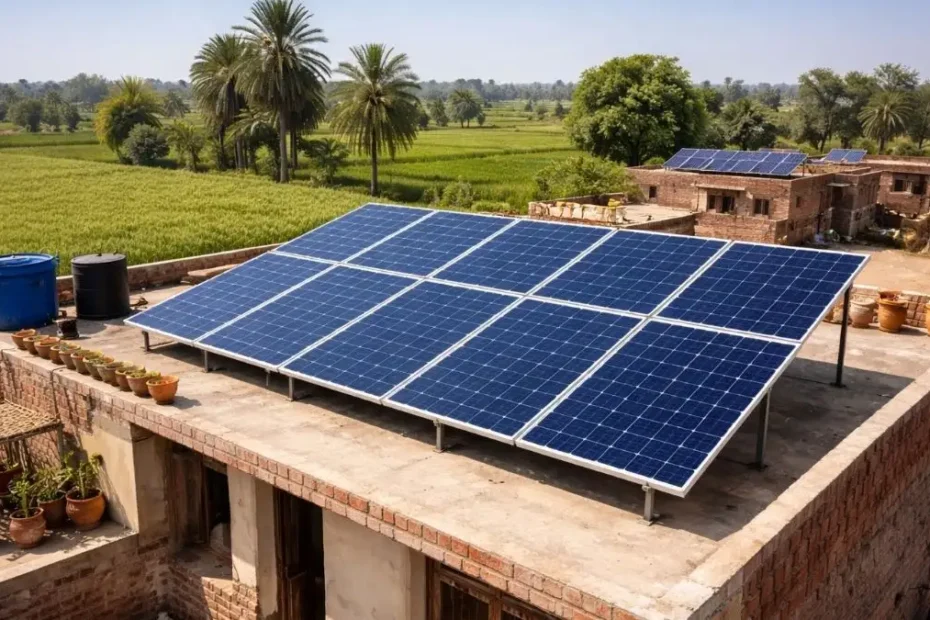
Punjab Chief Minister Maryam Nawaz extended the province’s flagship free solar panel scheme by six months on Tuesday, pushing the deadline from June 2026 to December 2026 and expanding its scope to over 94,000 solar systems at a revised cost of nearly Rs 10 billion — a decision driven by over 800,000 applications already received against the scheme’s original 100,000 system target. The extension, issued on the CM’s direct instructions, covers all districts and tehsils of Punjab, with systems distributed free of charge to low-income consumers through a transparent computerised balloting process.
On the instructions of Chief Minister Maryam Nawaz, the scheme’s deadline has been extended to December 2026. Under the revised plan, more than 94,000 solar systems will be provided at an estimated cost of nearly Rs 10 billion. The solar systems will be distributed free of cost to low-income consumers through a balloting process. The scheme will be implemented across all districts and tehsils of Punjab. Officials report that over 800,000 applications have already been received. The program was previously scheduled to run until June 2026 but has now been extended to accommodate increased demand and expanded distribution.
| Parameter | Previous | Revised |
|---|---|---|
| Scheme deadline | June 2026 | December 2026 |
| Systems to be distributed | 100,000 | 94,000+ (revised figure) |
| Total scheme cost | — | ~Rs 10 billion |
| Applications received | — | 800,000+ |
| Distribution method | Balloting | Balloting (unchanged) |
| Coverage | All Punjab districts | All districts + tehsils |
The 800,000-application figure tells the story directly. With an original target of 100,000 systems, the scheme was oversubscribed by 8-to-1 from the outset — a demand signal that the Punjab administration could not ignore, particularly with Pakistan’s electricity crisis reaching its sharpest point in years. April 2026 brought diesel at Rs 520.35/litre and petrol at Rs 378.41/litre following the Middle East conflict energy shock. WAPDA electricity tariffs had already risen sharply through FY25–26. For a low-income Punjab household paying Rs 3,000–6,000 per month in electricity bills, a free solar system delivering full energy independence represents one of the highest-value government transfers currently on offer anywhere in Pakistan.
The extension also aligns with the broader Rs 200 billion austerity relief package the federal and provincial governments rolled out in April 2026 — the solar scheme now sits alongside the Rs 2,000/month motorcycle petrol subsidy, free public transport across Punjab, and the farm diesel subsidy as part of CM Maryam Nawaz’s fuel crisis response portfolio.
The scheme covers domestic consumers with monthly consumption of up to 200 units. Consumer eligibility includes a sanction load of up to 2 KW. Domestic consumers involved in electricity theft are not eligible. Domestic consumers with defective meters are not eligible. Domestic consumers with multiple meters at a single residence are not eligible.
Based on consumption, eligible households receive:
- 0–100 units/month: 550-watt solar system
- 101–200 units/month: 1,100-watt (1.1 kW) solar system
Each system includes solar panels, battery backup, inverter, and professional installation — at zero cost to the beneficiary. The scheme targets households dependent mainly on lights and fans, and specifically prioritises women-led households, widows, disabled citizens, and rural residents.
How to Apply
Eligible residents can apply through three channels:
Online: Visit cmsolarscheme.punjab.gov.pk — register with CNIC, electricity bill reference number, and basic personal details.
SMS: Send CNIC number to the designated Punjab government shortcode (available on the official portal).
Offline: Visit the nearest Punjab government e-Khidmat centre or facilitation desk for assisted registration.
After application, selection proceeds through a computerised balloting system to ensure transparency. Applicants can check their status online at cmsolarscheme.punjab.gov.pk by entering their CNIC or reference number.
The Rs 10 billion allocation for 94,000+ solar systems works out to approximately Rs 106,000 per system — a figure consistent with current market pricing for a 550W–1.1kW solar kit with battery backup and professional installation in Pakistan. The Punjab government funds this from its NFC share, which was confirmed at approximately Rs 100 billion for the three-month fuel crisis relief package. The solar scheme represents a structural, long-duration expenditure rather than a monthly cash transfer — each installed system delivers energy savings for 20–25 years and permanently reduces the household’s dependence on the national grid.
With electricity prices in Pakistan at record highs and no near-term prospect of tariff reduction, the scheme’s economic value to each beneficiary is substantial: at current tariff rates, a 1.1kW system eliminating 180 units of monthly consumption saves a household approximately Rs 4,500–6,000 per month, or Rs 54,000–72,000 per year — a payback period of under two years on a system costing the government Rs 100,000+.
CM Maryam Nawaz officially launched the CM Punjab Free Solar Panel Scheme in December 2024, targeting 100,000 solar systems for electricity consumers using up to 200 units per month, enabling them to transition to solar energy without incurring any costs.The scheme, formally known as the CM Punjab Free Solar Panel Scheme and colloquially as the Roshan Gharana Solar Program, is one of several CM Maryam Nawaz welfare programmes running through the Bank of Punjab infrastructure and PITB’s digital delivery platforms. The April 2026 extension and budget expansion mark the first major revision to the scheme since its December 2024 launch.
how can i apply for the solar scheme
I want solar system