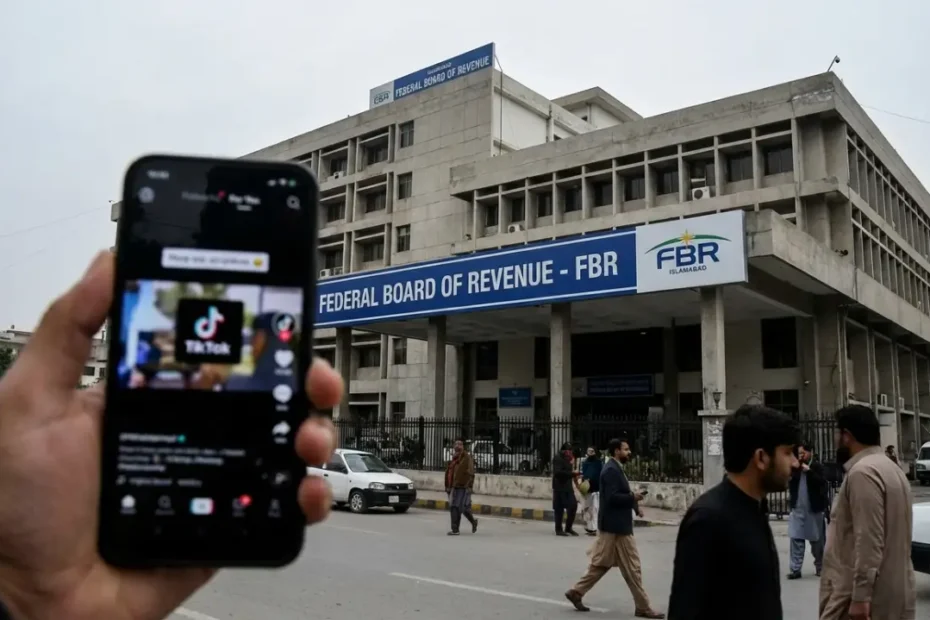
The Federal Board of Revenue issued SRO 546(I)/2026 and SRO 545(I)/2026 on April 1, 2026, proposing a dedicated income tax framework for Pakistani social media influencers and content creators earning from digital platforms. The draft rules, which amend the Income Tax Rules, 2002, fix a revenue per mille of Rs 195 per 1,000 YouTube views as the benchmark for calculating minimum taxable income.
FBR’s SRO 546(I)/2026 proposes inserting a new Chapter IIA into the Income Tax Rules, 2002, dealing specifically with income earned from remunerative social media content by resident individuals.
Taxable income under the draft equals total remuneration minus allowable expenses, with those expenses capped at 30% of total revenue. Where actual income falls below the computed benchmark, tax authorities hold the power to amend returns and recover outstanding liabilities.
The benchmark formula uses three variables: revenue per mille (RPM), average views per content piece, and total number of posts published during the tax year. The RPM stands fixed at Rs 195 per 1,000 views for YouTube content, though the FBR retains the right to revise this figure periodically.
Who Falls Under the Tax Net
The rules target two distinct groups of earners:
Resident creators — Pakistani influencers, YouTubers, TikTokers, bloggers, and digital entrepreneurs earning from platforms through advertising, sponsorships, brand collaborations, or subscriptions.
Non-resident creators — Foreign digital earners and non-resident content creators face taxation thresholds where their interaction with users in Pakistan exceeds 50,000 users in a tax year or 12,250 users in a quarter.
| Taxpayer Category | Threshold |
|---|---|
| Non-resident creators | 50,000 Pakistani users/year OR 12,250/quarter |
| Resident creators | All earning from remunerative social media content |
| Expense deduction allowed | Up to 30% of total revenue |
| YouTube RPM benchmark | Rs 195 per 1,000 views |
Quarterly Advance Tax and Filing Obligations
The proposed regime mandates quarterly advance tax payments, calculated on the prescribed formula and adjusted under existing provisions of the Income Tax Ordinance, 2001. Influencers must also declare their social media income in a dedicated section of the annual income tax return.
The FBR defines “social media platform” as any internet-based service that enables user interaction and monetises engagement or data. “Remunerative social media content” covers any content generating income in cash or kind — including advertisements, sponsorships, and collaborations — leaving no room for creators to exclude barter arrangements or gifted products with commercial value.
Legal Instruments and Effective Date
The draft rules cite two SROs issued simultaneously: SRO 546(I)/2026 covering resident individuals under the Income Tax Rules, 2002, and SRO 545(I)/2026 addressing the broader digital income framework. The FBR has invited stakeholders to submit objections and suggestions within seven days of the notification’s publication, after which the rules will be reviewed before finalisation.The seven-day window places the public comment deadline around April 8, 2026.
The draft SROs arrive as a natural follow-through to enforcement action already underway. FBR’s Directorate General of Intelligence and Investigation–Inland Revenue had earlier initiated recovery proceedings against 38 leading YouTubers, TikTok stars, and social media influencers for alleged concealment of income and unexplained wealth totalling Rs 15 billion, detected through the FBR’s Lifestyle Monitoring Cell.The new SROs shift the approach from reactive enforcement to a proactive, formula-based tax regime — closing the documentation gap before it becomes a larger compliance problem.
What This Means for Pakistani Content Creators
Any Pakistani creator monetising YouTube, TikTok, Instagram, Facebook, or similar platforms now faces a structured tax obligation — not merely the risk of an audit notice. The Rs 195 RPM benchmark means a channel averaging 500,000 views per month generates a computed monthly revenue of Rs 97,500 under the FBR’s formula, before the 30% expense deduction. Creators who declared zero or minimal income in prior tax years should seek advice from a registered tax practitioner before the final rules take effect. The quarterly advance tax requirement also means cash flow planning becomes essential — creators can no longer defer all tax liability to the annual return filing deadline.