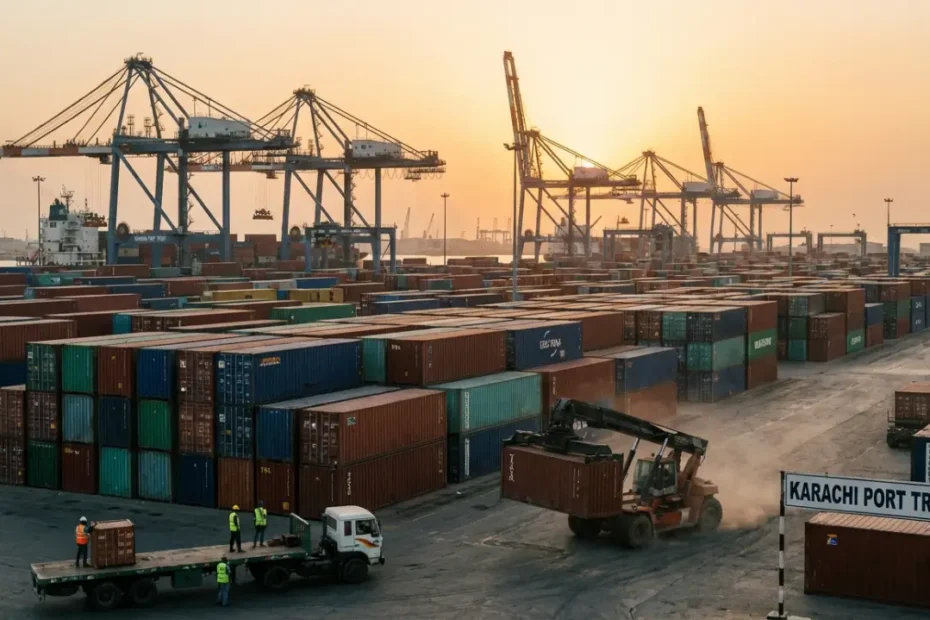
Pakistan’s trade deficit contracted sharply to $22.6 billion in July–March FY2025–26, an 18.5% year-on-year improvement from the deficit recorded in the same period last year, according to data released by the Pakistan Bureau of Statistics. Exports climbed 8.7% while imports fell 6.2%, marking one of the stronger nine-month trade performances in recent fiscal history.
What the Nine-Month Numbers Show
PBS data shows exports for 9MFY26 reached $24.7 billion, up from $22.73 billion in 9MFY25 — an $1.97 billion absolute gain driven by sustained momentum in textiles, IT services, and agri-based exports.
Imports declined to $47.3 billion from $50.53 billion a year earlier, a $3.23 billion compression that reflects both subdued domestic demand and the lagged impact of the SBP’s tight monetary policy cycle through much of FY25.
| Indicator | 9MFY26 | 9MFY25 | YoY Change |
|---|---|---|---|
| Trade Deficit | $22.6bn | $27.74bn | -18.5% |
| Exports | $24.7bn | $22.73bn | +8.7% |
| Imports | $47.3bn | $50.53bn | -6.2% |
March 2026 tells a more cautious story. The monthly trade deficit widened 3.7% YoY to $2.73 billion, even as both exports and imports fell in absolute terms.
Exports in March dropped to $2.26 billion — down 14.4% YoY and 0.5% month-on-month from February 2026 — a sharp single-month pullback that trade analysts will flag as a concern if it persists into Q4.
Imports in March stood at $4.995 billion, falling 5.4% YoY and 5.6% MoM from February’s $5.29 billion — offering some cushion on the deficit side but insufficient to offset the steeper export decline.
On a sequential basis, the March deficit of $2.73 billion improved 9.4% from February’s $3.01 billion, suggesting month-on-month momentum remains broadly in the right direction.
| March Indicator | Mar 2026 | Mar 2025 | YoY | MoM |
|---|---|---|---|---|
| Trade Deficit | $2.73bn | $2.63bn | +3.7% | -9.4% |
| Exports | $2.26bn | $2.64bn | -14.4% | -0.5% |
| Imports | $4.995bn | $5.28bn | -5.4% | -5.6% |
The PBS data release has not yet drawn a formal statement from the Ministry of Commerce or TDAP as of publication time. However, trade economists tracking Pakistan’s current account have noted that the nine-month improvement is structurally significant — cumulative export growth of 8.7% outpacing the prior year’s pace reflects genuine order-book strength in Pakistan’s textile corridor, particularly in value-added segments.
The March export dip of 14.4% YoY warrants monitoring. Analysts at brokerage houses covering Pakistan’s macro picture have flagged that regional supply chain disruptions and currency volatility among key trading partners — including the United States and the European Union — could compress export receipts in Q4 FY26 if global demand softens.
What This Means for Pakistan’s Economy
For the broader economy, an 18.5% shrinkage in the nine-month trade deficit directly supports the current account position — a metric the IMF watches closely under Pakistan’s ongoing Extended Fund Facility. A narrower current account deficit reduces pressure on foreign exchange reserves and gives the SBP — currently holding the policy rate at 12% — more room to sustain or deepen its easing cycle without triggering import-driven currency pressure.
For Pakistani exporters — particularly SME textile manufacturers in Faisalabad and Sialkot — the nine-month export gain of 8.7% validates order strength. Still, the March single-month drop signals that forward order pipelines may be tightening. Importers and businesses reliant on raw material imports will note that the 6.2% import compression reflects both policy restraint and weaker domestic purchasing power — not yet a demand recovery signal.