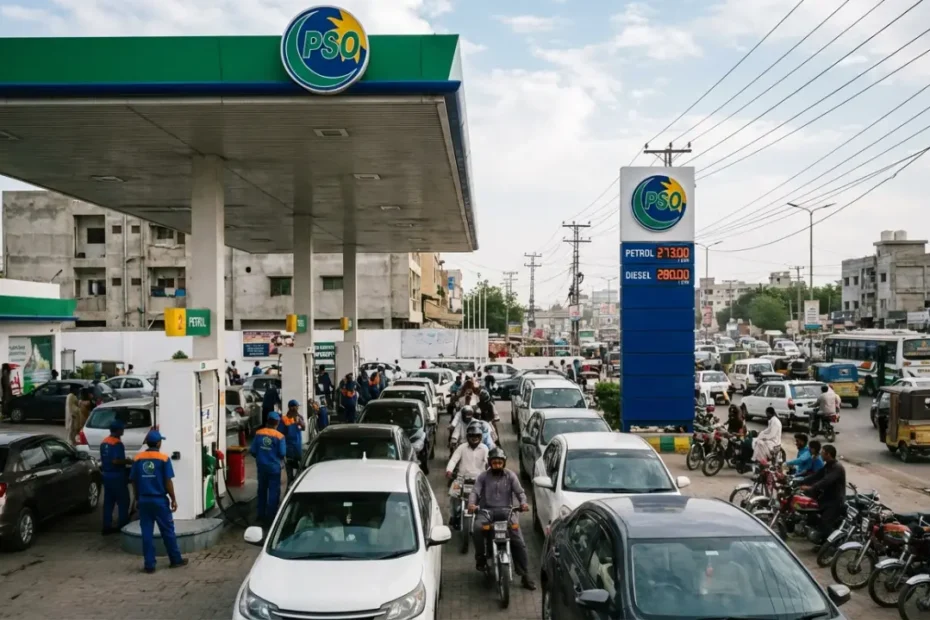
Pakistan’s oil marketing companies sold 1.44 million tons of petroleum products in March 2026, a 19% year-on-year jump from 1.22 million tons in March 2025, according to data compiled by Topline Securities. The surge came despite elevated petrol and diesel prices during the month, signalling resilient underlying fuel demand across transport, agriculture, and industry.
Month-on-Month Momentum Holds
Industry-wide sales also rose 13% compared to February 2026, pushing cumulative petroleum offtake for the first nine months of FY2025–26 to 12.4 million tons — up 5% from 11.77 million tons recorded in the same period last fiscal year.
Excluding furnace oil, nine-month sales reached 12 million tons, reflecting a stronger 7% YoY gain — indicating broad-based demand growth beyond power sector fuel switching.
Product-Wise Breakdown
Motor spirit (MS) sales reached 670,000 tons in March — up 16% YoY and 8% MoM — driven by steady private and commercial transportation activity.
High-speed diesel (HSD) posted 590,000 tons, rising 21% YoY and 13% MoM, reflecting continued momentum in agriculture, logistics, and heavy transport ahead of the wheat harvest season.
Furnace oil (FO) recorded the sharpest acceleration, with volumes hitting 88,000 tons — a 62% YoY surge and a 98% MoM spike — attributed primarily to a low base from March 2025 and a pickup in industrial power generation demand.
Company-Wise Performance
| OMC | March 2026 Sales (tons) | YoY Change |
|---|---|---|
| Pakistan State Oil (PSO) | 627,000 | +23% |
| Attock Petroleum (APL) | 114,000 | +8% |
| Wafi Energy Pakistan | 103,000 | +17% |
| Hascol Petroleum | 45,000 | Slightly negative |
Pakistan State Oil extended its market leadership with 627,000 tons sold — capturing roughly 44% of total industry volume in March and growing faster than the sector average at 23% YoY.
Attock Petroleum and Wafi Energy both posted solid gains, while Hascol Petroleum remained under pressure, recording a marginal YoY decline at 45,000 tons.
Topline Securities, which compiled the OMC data, flagged furnace oil’s near-doubling on a MoM basis as a base-effect phenomenon rather than a structural demand shift, cautioning against reading it as a sustained industrial recovery signal. Independent fuel sector analysts have noted that HSD’s 21% YoY rise aligns with the Pakistan Bureau of Statistics reporting stronger agricultural activity in Punjab and Sindh ahead of the Rabi harvest.
For PSX-listed OMCs — particularly PSO and APL — the March volume surge is a direct positive for quarterly revenue and throughput margins, which investors will watch closely in upcoming Q3 FY2026 results. For consumers, the volume growth confirms demand has held firm despite petrol prices remaining elevated, suggesting price elasticity in Pakistan’s fuel market is lower than previously estimated. For the government, higher petroleum offtake feeds directly into petroleum levy and sales tax collections — both critical to FBR’s Rs 12,970 billion revenue target for FY2024–25.
Pakistan’s petroleum sector had recorded suppressed demand through much of FY2024–25 as high fuel prices and tight consumer spending compressed volumes. The YoY recovery now visible across three consecutive months of FY2025–26 data points to a demand rebound tied to lower inflation, improved agricultural income, and a gradual easing of economic pressure on transport operators.
For the latest regulatory and market data, stay current at taxtoday.pk.