Let’s be honest with ourselves for a moment. The US-Israel war on Iran, which began on 28th February 2026, has caused real and serious pain for Pakistan’s economy. But if we’re looking for someone to blame for how vulnerable we are right now, we shouldn’t only be pointing towards the Strait of Hormuz. We should also be looking a lot closer to home.
The conflict caused immediate volatility in energy markets, with Brent crude oil prices surging 10 to 13 per cent to around $80 to $82 per barrel in the opening days of the war. Iran’s closure of the Strait of Hormuz disrupted 20 per cent of global oil supplies, along with significant liquefied natural gas volumes. Since then, things have only gotten worse. Brent crude pushed from roughly $73 a barrel on 27th February to a peak of $120 on 9th March — a 65 per cent increase — before settling back near $100 as the International Energy Agency’s members released 400 million barrels from global stockpiles.
Pakistan finds itself in an especially bleak position. The country imports 40 per cent of its energy and relies heavily on liquefied natural gas from Qatar, supplies of which have been effectively cut off by the conflict.And unlike larger economies with deep reserves to cushion the blow, Pakistan and Indonesia maintain strategic oil reserves of only around 20 days — barely enough time to negotiate alternatives before the lights start flickering.
The government’s response has been swift, if not entirely painless. Prime Minister Shehbaz Sharif announced emergency austerity and fuel conservation measures in a televised address, warning that disruptions to maritime traffic in the Strait of Hormuz had placed Pakistan’s economy under direct threat. The measures included a four-day workweek for government employees, with 50 per cent of staff working from home on rotation. Schools were closed, all in-person meetings across federal and provincial governments were banned, and weddings and social gatherings were capped at 200 guests with one main dish.
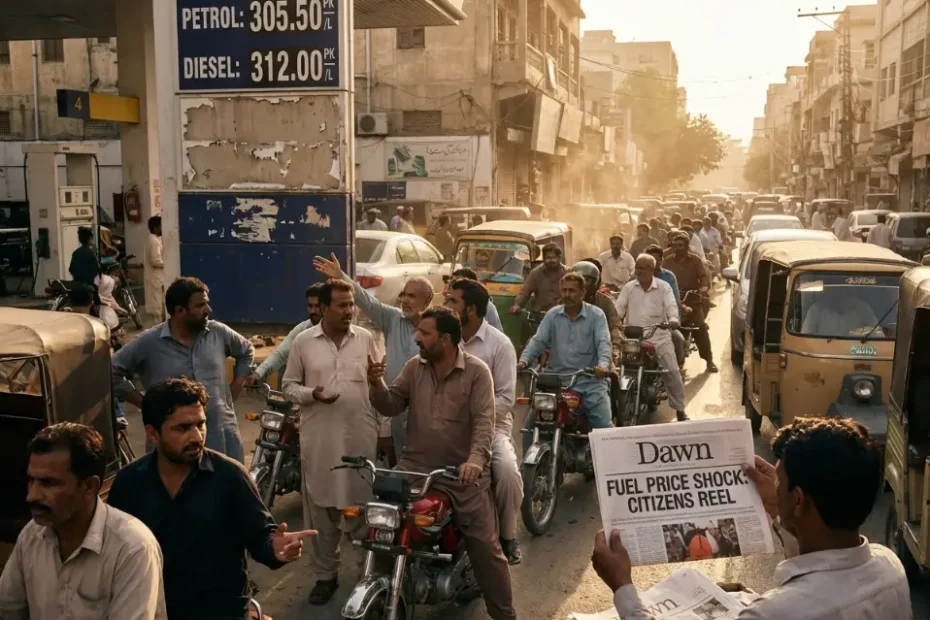
The most visible sign of the crisis for ordinary Pakistanis has been at the petrol pump. Petrol increased from Rs266.17 to Rs321.17 per litre, while diesel jumped from Rs280.86 to Rs335.86. The government separately hiked taxes on high-octane fuel — the kind used in luxury vehicles — from Rs100 to Rs300 per litre, in a move marketed as making the rich shoulder more of the national burden.
The high-octane tax hike is, in theory, the right instinct. But in practice, it illustrates exactly the problem with how Pakistan has always managed crisis — tokenism dressed up as policy. Yes, taxing luxury fuel is symbolic justice. But it does almost nothing to fix the structural rot underneath.
Think about it this way: Pakistan is a country of roughly 250 million people, and only about three per cent of them are registered tax filers, with even fewer actually contributing anything meaningful. Across decades, an entire class of visibly wealthy traders, landlords, and industrialists has successfully resisted budget measures to pay their fair share. Meanwhile, indirect taxes — petrol levies, GST, electricity surcharges — have been piled onto the same working-class people who can least afford them. The Iran war didn’t create this injustice. It just made it impossible to ignore.
Economists note that far from cutting interest rates to provide relief, Pakistan’s central bank will probably have to raise them instead. Inflation was already uncomfortably high, and higher energy prices threaten to make it significantly worse.The IMF programme that is currently keeping Pakistan solvent was designed for a world before $100 oil. According to IMF analysis, every 10 per cent rise in oil prices corresponds with a 0.4 per cent rise in inflation and a 0.15 per cent reduction in economic growth. Do the maths on a 60 per cent oil price surge and what that means for a country already stuck in a low-growth cycle.
Energy analyst Amer Zafar Durrani, a former World Bank official, put it plainly: the real macroeconomic trigger is currency depreciation, which amplifies the impact of higher oil prices on domestic inflation. He argued that the long-term solution lies in harnessing more electric power for transport, reducing industrial reliance on diesel, and expanding renewable energy — warning that without these structural changes, every global energy shock will continue threatening Pakistan’s economy.
That last point is worth sitting with. Pakistan has been through this before — not with the same war, but with the same helplessness. Every time there is a global energy shock, we scramble, we announce austerity packages, we raise petroleum levies, and then we wait for things to stabilise. Then we go right back to doing nothing. There is no serious renewable energy transition plan. There is no diversification of LNG suppliers. There are no strategic fuel reserves worth speaking of. And there is certainly no honest conversation about making the elite of this country pay what they owe.
The climate dimension cannot be brushed aside either. Pakistan’s disaster management officials have already warned that this year’s rainfall cycle could exceed last year’s by at least 20 per cent — and last year’s floods caused widespread destruction and displacement across the country. Up to 30 per cent of the world’s fertiliser exports pass through the Strait of Hormuz, including urea, ammonia, phosphates, and sulphur. Disruption has already cut off fertiliser shipments, raising costs for farmers and pushing food prices higher globally. For a country where agriculture remains the backbone of both employment and food security, this is not a distant concern — it is arriving at the farm gate right now.
Finance Minister Muhammad Aurangzeb has directed officials to engage with the State Bank and commercial lenders to explore measures including enhanced limits and consortium-based financing to ensure continuity of fuel imports. The government says diesel stocks currently provide around 24 days of cover, with petrol at comfortable levels supported by ongoing imports and refinery operations.Pakistan Railways has also been directed to upgrade freight facilities to reduce dependence on road transport, which is a sensible medium-term measure — but one that comes years too late to matter right now.
What Pakistan urgently needs — not just to survive this crisis but to stop being perpetually exposed to the next one — is a genuine rethink of its social contract. The rich must be compelled to file and pay taxes honestly, not symbolically. Elected representatives who have for decades enjoyed first-class travel, luxury vehicles, sprawling government residences, and subsidised utilities must be told that those days are over — not as a talking point, but as legislation. The agricultural sector, which could be the fastest pathway to economic revival and food security, needs serious investment, not seasonal attention. And Pakistan’s non-profit and philanthropic sector — which is genuinely one of the most generous in the world — needs a proper regulatory and institutional framework so that private giving can be channelled into lasting development rather than one-off relief.
Analysts warn that unlike the Russia-Ukraine war, which caused a temporary shock that eventually normalised, the 2026 Iran conflict has created a physical chokepoint that cannot be compensated for through rerouting or substitution. The longer the Strait of Hormuz remains disrupted, the longer oil and gas prices will stay elevated — and the tools used in 2022 simply will not work this time.
Pakistan cannot control what happens in the Persian Gulf. But it can — finally — take control of what happens within its own borders. The question is whether the ruling class, which has historically been the last to sacrifice anything, will choose this moment to be different. History, unfortunately, does not give much reason for optimism. But the alternative — limping from one global crisis to the next, each time more exposed than before — is simply no longer survivable.