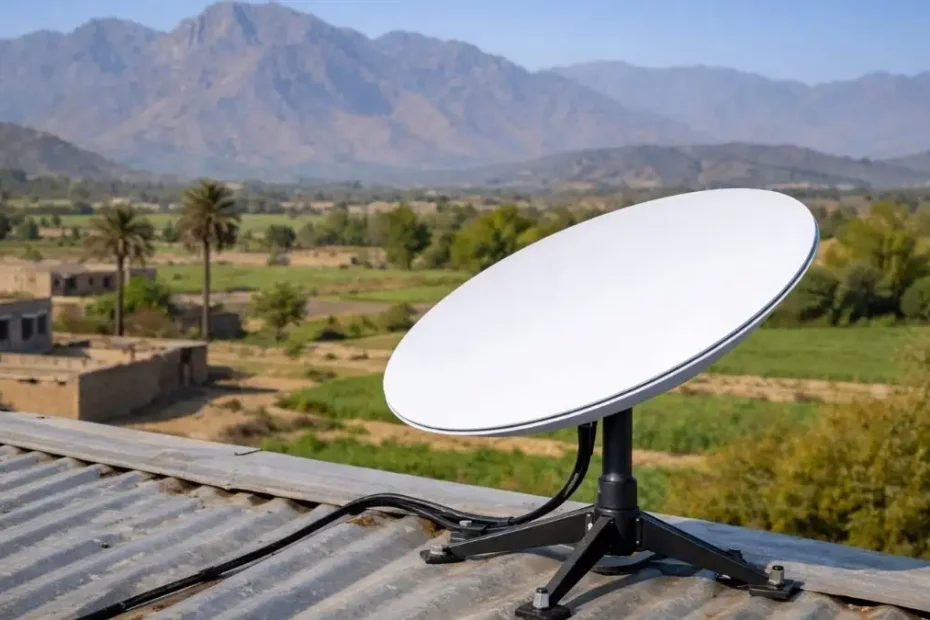
The Pakistan Telecommunication Authority has cleared all regulatory obstacles standing between Starlink and Pakistan’s consumers, formally opening the country to satellite-based internet services after a four-year approval odyssey marked by security reviews, data sovereignty disputes, geopolitical caution, and institutional logjams across multiple agencies.
The breakthrough — coming weeks after Pakistan’s Senate publicly castigated the government for prolonged delays — marks the formal launch of a new era in Pakistan’s telecommunications market, with Starlink, OneWeb, Shanghai Spacecom Satellite Technology, Amazon’s Project Kuiper, and Telesat all now in a position to apply for and receive operational licences.
Final Regulatory Clearance
The last major barrier was the Federal Cabinet approval of PTA’s Fixed Satellite Services (FSS) licensing framework — a step that had been pending since PTA forwarded the finalised framework to the IT Ministry in late February 2026. Satellite companies will be required to obtain PSARB registration before applying for PTA licences. Under the finalised FSS framework, licences will be issued on a simplified, non-exclusive basis with a validity of 15 years.
The draft framework has been forwarded to the Ministry of IT and Telecommunication, which will review it and then present it to the Federal Cabinet for approval. Cabinet clearance is a mandatory step before satellite internet companies can formally apply for operational licences in Pakistan.
With Cabinet approval now confirmed and the PSARB registration regime in place, the two-step process — PSARB registration followed by PTA operational licence — is open for all five companies that have been waiting.
| Parameter | Detail |
|---|---|
| Licences required | 1 (down from 15 previously) |
| Licence fee | $500,000 (down from $640,000) |
| Validity | 15 years |
| Service rollout deadline | Within 18 months of approval |
| Infrastructure requirement | Minimum 1 Gateway Earth Station in Pakistan |
| Data requirement | All user data must remain within Pakistan’s borders |
| USF contribution | 1.5% of gross revenues |
| Spectrum fee | 0.5% of revenues |
| Annual licence fee | 0.5% of revenues |
Under the new provisions, licensees will only require one licence to provide satellite internet services as opposed to the previous requirement of two separate licences. The licence fee has decreased from $640,000 to $500,000. The licence will be valid for 15 years, and service must be rolled out within 18 months of licensing, including at least one Gateway Earth Station located in Pakistan.
Pakistan’s satellite internet journey is one of the longest licence approval processes in the country’s telecom history:
| Date | Milestone |
|---|---|
| Feb 2022 | Starlink submits first LDI licence application to PTA |
| Oct 2024 | PTA confirms licence “finalised in principle,” security clearance pending |
| March 21, 2025 | PSARB grants Starlink temporary NOC; IT Minister Shaza Fatima announces “provisional permission” |
| April 2025 | IT Minister tells parliamentary committee Starlink to launch by November/December 2025 |
| July 2025 | Reports Elon Musk may attend Pakistani launch ceremony |
| Sept 15, 2025 | PTA releases draft FSS licensing framework; public consultation closes Sept 19 |
| Jan 2026 | PTA develops dedicated cybersecurity regulations for satellite services |
| Feb 8, 2026 | Approval put on hold — data bypass concerns, Trump-Musk dispute, Chinese competition cited |
| Feb 26, 2026 | PTA finalises FSS framework; forwarded to IT Ministry for Cabinet submission |
| April 1, 2026 | Senate slams government for “crucial delays” in satellite internet licensing |
| April 15, 2026 | PTA clears all hurdles — satellite internet licences open |
The February 2026 hold on Starlink’s approval revealed the depth of institutional resistance. The government had come to know that Starlink could transmit certain data while bypassing Pakistan’s monitoring, regulatory and safety checks. Officials feared they would not have similar control over satellite-based internet data and that foreign companies, particularly Starlink, might be involved in data theft. At present, Pakistan retains control over internet data as Pakistan Telecommunication Company Limited (PTCL) is a majority shareholder in the undersea cable infrastructure.
Sources said the Trump-Musk fallout had also become a reason the Pakistani establishment was not ready to grant security clearance, fearing it could provoke displeasure from Washington. Pakistan and the US have enjoyed improved relations since Trump returned to power, and therefore, Pakistan did not want to take any step that could raise concerns in Washington.
The resolution of these concerns — through the cybersecurity framework requiring local data routing, lawful interception capabilities, and mandatory Pakistan-based gateway earth stations — ultimately unlocked the clearance.
The Five Companies Now in Line
According to the Pakistan Space Activities Regulatory Board, five companies have shown strong interest in providing satellite internet services: Starlink (SpaceX), Shanghai Spacecom Satellite Technology Limited (SSST), OneWeb of the Eutelsat Group, Amazon’s Project Kuiper, and Canadian satellite operator Telesat. Most of these firms have already completed significant preparatory work for launching their services.
Starlink is the most technically prepared — it has held a temporary PSARB NOC since March 2025, registered with the SECP and Pakistan Software Export Board, and signed a retailer agreement with Paksat. Starlink’s proposed investment in Pakistan includes millions of dollars for local network infrastructure, such as purchasing colocation space in data centres, fibre optic connectivity, and construction materials, as well as recurring operational expenditures that would benefit local businesses including Paksat.
What to Expect — Timeline and Pricing
Under the new FSS framework, licensed operators must roll out services within 18 months of receiving their PTA licence. For Starlink — the furthest along in preparations — this means commercial service is possible before the end of 2026 in best-case scenario, with rural and remote areas likely to be the first deployment priority.
Expected pricing benchmarks based on Starlink’s global pricing at current exchange rates: hardware (satellite dish + router) approximately Rs 110,000–120,000, one-time, monthly subscription approximately Rs 35,000–50,000. These figures would place Starlink firmly in the enterprise, SME, and upper-consumer segments rather than the mass-market consumer segment for the first wave — though prices may shift as competition arrives.
Pakistan has approximately 100 million unbanked adults and an estimated 60–70 million people in areas where terrestrial broadband either does not reach or delivers below 1 Mbps. Satellite LEO internet — with median download speeds of 50–200 Mbps and latency of 20–40ms — would represent a qualitative leap in connectivity for these communities. For Pakistan’s 3–4 million freelancers, whose foreign exchange earnings contribute significantly to the current account, reliable rural internet would directly expand the addressable workforce. For the government’s digital payments and e-government services agenda, satellite connectivity would extend digital financial inclusion into areas where mobile data quality currently makes app-based services unreliable.