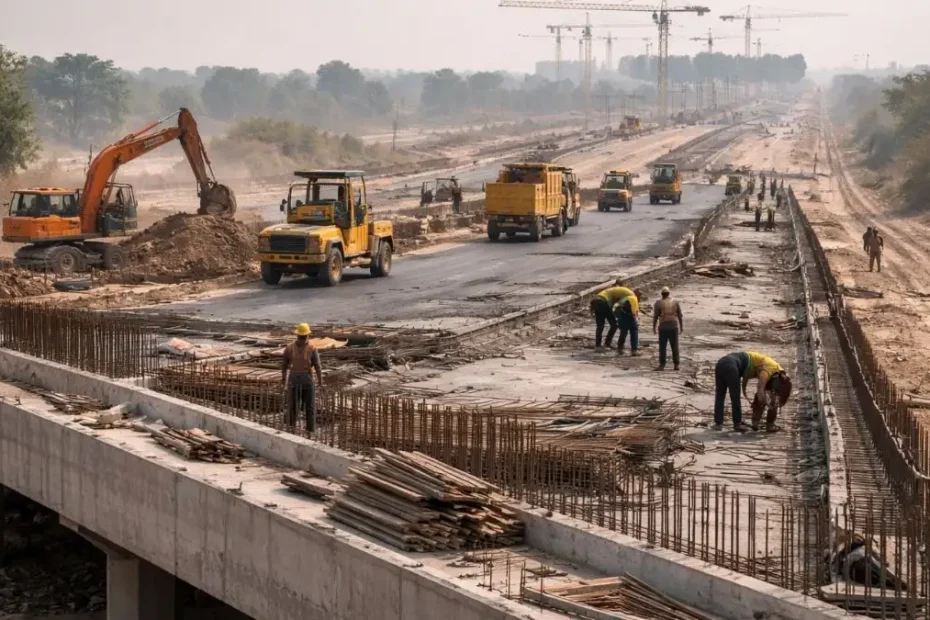
The federal government utilised only Rs 361 billion — 36% — of its Rs 1 trillion Public Sector Development Programme (PSDP) allocation in the first eight months of FY2025-26, according to data from the Ministry of Planning and Development, as the combination of IMF-mandated fiscal discipline, a crippling fuel crisis, and Pakistan’s chronic project execution failures left the country’s already-thin development pipeline starved of funds. The underutilisation comes after the government had already slashed the PSDP by Rs 100 billion — a 10% uniform cut — specifically to finance the Rs 80/litre petroleum levy reduction announced by PM Shehbaz Sharif on 4 April 2026.
| Period | PSDP Allocation | Funds Released | Actual Utilisation | % Used |
|---|---|---|---|---|
| Jul–Nov 2025 (5 months) | Rs 1,000 billion | Rs 349 billion | Rs 92 billion | 9.2% |
| Jul–Feb 2026 (8 months) | Rs 900 billion* | — | Rs 361 billion | 36% |
| Full-year target | Rs 900 billion | — | Q4 sprint needed | 64% left |
Planning Minister Ahsan Iqbal confirmed that a uniform 10% cut has been applied across all development projects. The decision, made in consultation with the Ministry of Finance, aims to control non-essential expenditures amid global economic tensions and ongoing IMF review talks.
The federal government reduced the development budget by Rs 100 billion to keep petrol and diesel prices steady. So far, only Rs 361 billion or 36% of the allocated PSDP funds had been utilised during the first eight months of the fiscal year.
The logic is fiscally coherent on paper: with the Rs 80/litre petrol levy cut costing the government roughly Rs 12–15 billion per month in foregone petroleum levy revenue, squeezing an already-underperforming PSDP offered a non-disruptive way to generate fiscal space without raising additional taxes. But the decision adds a fourth year in a row of development budget compression to Pakistan’s investment shortfall — in a country where the throw-forward liability (cost of approved-but-unfunded projects) already stood at Rs 10,216 billion as of June 2025.
Infrastructure received Rs 626.77 billion — 63% of the total PSDP allocation for FY26 — of which only Rs 55.24 billion had been utilised by November 30. Within infrastructure, transport and communication accounted for the largest allocation of Rs 333.48 billion, with spending of just Rs 30.43 billion. The energy sector recorded expenditure of Rs 3.52 billion against an allocation of Rs 122.65 billion — utilisation of less than 3%. Physical planning and housing spent Rs 7 billion out of Rs 72.73 billion — 9.6%.
State-owned corporations — including the National Highway Authority, NTDC, and PEPCO — were allocated Rs 317.74 billion and received Rs 111.21 billion in releases, but spent only Rs 23.49 billion by November. The NHA, Pakistan’s flagship infrastructure agency, was allocated Rs 226.98 billion for FY26 and spent just Rs 20.74 billion — 9.1% of its annual target.
Despite a budget surplus of 1.6% in the first quarter, supported by higher State Bank profits and petroleum levy collections, development releases remained constrained. The government provided written contingency commitments to the IMF following the $1.2 billion disbursement, as the cumulative revenue shortfall reached Rs 430 billion in the first five months. Under these commitments, if FBR collections continued to underperform and other receipts failed to compensate, the government would defer an equivalent amount of expenditure to the final quarter of FY26.
The result is a self-reinforcing cycle: Pakistan’s IMF commitments require a primary surplus of 1.6% of GDP. FBR missed its 9-month target by Rs 610 billion. The government compensates by compressing development spending — the most visible expenditure line with the least immediate political cost — rather than taking on politically sensitive revenue measures targeting agriculture, real estate, and the informal sector. The PSDP absorbs the adjustment. Infrastructure stalls. Growth suffers. The tax base stays narrow. The IMF returns with higher targets.
The Ministry of Planning, Development and Special Initiatives is unlikely to allocate fresh funds for new projects under PSDP 2026-27 due to limited financial resources. The Power Division was directed not to recommend new projects for PSDP 2026-27, with officials noting that even ongoing projects may not receive allocations under current fiscal constraints.
The Ministry of Water Resources sought Rs 190 billion for Mohmand Dam in the next PSDP — only Rs 20 billion was committed. The implications extend beyond one dam: as of June 2025, 1,120 projects were included in the PSDP with an approved cost of Rs 13,427 billion, of which Rs 3,216 billion had already been spent. A throw-forward liability of Rs 10,216 billion remains, underscoring the urgent need for project rationalisation and financial discipline.
Federal Planning Minister Ahsan Iqbal has consistently linked PSDP execution to GDP growth. His argument is mathematically sound: development spending has a direct bearing on growth and job creation. The only way to increase development spending is to increase revenues by increasing the tax/GDP ratio from 10% to 16–18%.
Pakistan’s GDP growth target for FY2026 stands at 3.6-4.2%. With PSDP execution at 36% after 8 months and already cut by 10%, analysts at multiple brokerage houses project actual FY2026 growth to land in the 2.5–3% range — consistent with FY2025’s 2.68% outturn and nowhere near the 4-5% the IMF’s medium-term projections require for debt sustainability.
For contractors, construction companies, civil engineering firms, and the hundreds of thousands of workers employed on government infrastructure projects across Pakistan, the underperforming PSDP translates directly into delayed contracts, unpaid bills, and site stoppages — adding to the inflationary and unemployment pressures already being driven by the fuel price crisis.