
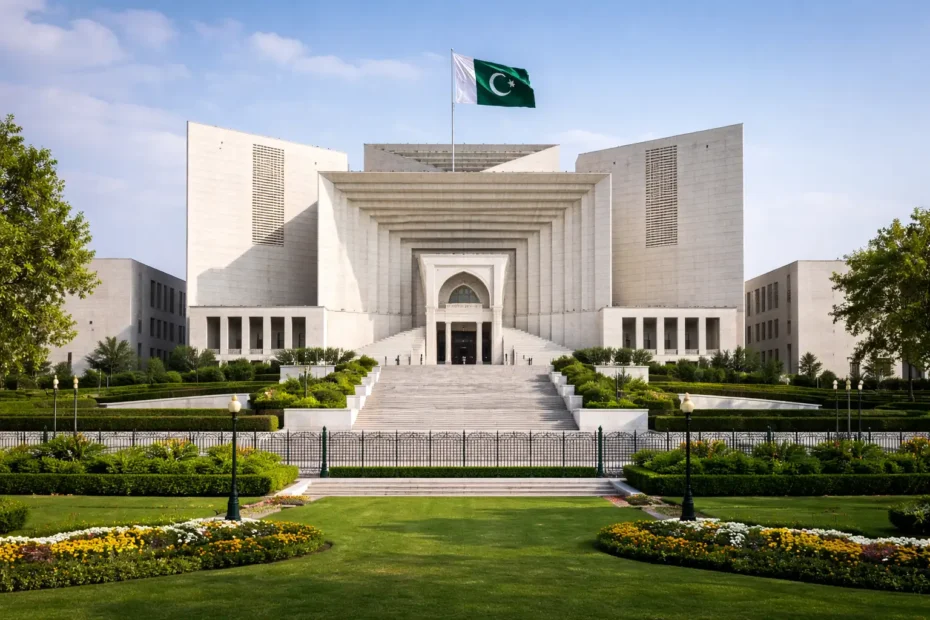
Pakistan’s Federal Constitutional Court (FCC) summoned the records of cases pending before multiple high courts regarding the constitutional validity of Section 7E of the Income Tax Ordinance 2001 on Monday, scheduling 319 consolidated appeals for day-to-day hearing during the next judicial week. The FCC bench, headed by Chief Justice Ameenuddin Khan, acted on appeals transferred from the Supreme Court of Pakistan under the 27th Constitutional Amendment — making the FCC the new apex forum for all constitutional interpretation questions including those at the heart of Pakistan’s most contested real estate tax.
Section 7E, introduced through the Finance Act 2022 (effective Tax Year 2022 onwards), imposes tax on “deemed income” from capital assets held by resident persons in Pakistan. Section 7E imposes taxes on deemed income from capital assets, primarily immovable property such as buildings and land, even if they are not rented out. The formula: 5% of the FBR-reported fair market value is treated as deemed income, chargeable to tax at 20% — meaning the effective tax rate is 1% of the property’s fair market value annually.
The tax applies when the aggregate fair market value of all capital assets (excluding exempted categories) exceeds Rs 25 million. A person’s self-owned business premises where business is actively conducted, self-owned agricultural land, and properties owned by war-wounded soldiers or families of Shaheeds are among the exemptions.
The constitutional challenge centres on a fundamental question: does Parliament have the legislative competence to impose this tax, or does taxing immovable property exclusively belong to provincial assemblies under the 18th Amendment?
A holistic reading of Section 7E shows that it is, in pith and substance, a tax on the fair market value of immovable property situated in Pakistan, held on the last day of a tax year by a resident person. It imposes tax of 20% on deemed income — an amount equal to 5% of FMV if in aggregate the value is Rs 25 million or more. Critics argue Section 7E represents a capital value tax on immovable property and not a tax on income derived from it.
The high courts reached conflicting conclusions. The Sindh High Court upheld the tax, while the Lahore High Court ruled against it. This is the reason properties in Punjab have been excluded from Section 7E enforcement pending final adjudication.
The Chief Justice of the Islamabad High Court upheld the legislative mandate under Entry 47, Part I of the Federal Legislative List, Fourth Schedule to the Constitution. However, he simultaneously declared Section 7E ultra vires of the Constitution, adjudging it “confiscatory in nature, hence in violation or derogation of Article 23 of the Constitution.”
The core constitutional argument against Section 7E: under Entry 50 of the Federal Legislative List, Parliament can only impose “taxes on the capital value of assets, not including taxes on immovable property.” Since Section 7E levies tax on immovable property by treating 5% of its FMV as deemed income, it falls outside Parliament’s legislative competence, as the right to impose any kind of tax on immovable property exclusively vests with provincial assemblies under Article 142(c) of the Constitution after the 18th Amendment.
The 319 appeals were transferred to the FCC from the Supreme Court of Pakistan in view of the 27th Constitutional Amendment. The appeals originate from different high courts across the country and raise important constitutional questions about the scope of federal taxation powers, the distinction between income and property taxation, and the legality of “deemed income” under Pakistani law.
Under the 27th Constitutional Amendment, the FCC now holds exclusive jurisdiction over constitutional interpretation and federal-provincial disputes. Any cases or petitions pending before any other court that fall under the FCC’s jurisdiction stand transferred to the FCC. As a result, all Section 7E cases raising constitutional questions have migrated from the Supreme Court and high courts to the FCC.
On behalf of FBR, Advocate Hafiz Ahsan Khokhar and Advocate Asma Hamid appeared before the FCC and argued that additional appeals related to this case were pending before the Islamabad High Court — indicating the full caseload may exceed the 319 appeals already consolidated.
Section 7E has been a significant revenue instrument for FBR. The FBR’s current FY2025–26 tax collection target stands at Rs 12,970 billion, against which the board already faces a Rs 640 billion eight-month shortfall. Any FCC ruling that strikes down Section 7E in whole or part would remove a meaningful revenue line from FBR’s collection toolkit and could force the government to seek alternative property taxation measures — potentially triggering IMF discussions on revenue replacement.
The Federation of Pakistan Chambers of Commerce and Industry (FPCCI) has consistently called for the withdrawal of Section 7E, arguing it generated only Rs 10 billion in revenue in its first year while causing disproportionate damage to investor sentiment in the domestic and overseas Pakistani real estate community. FPCCI also argued that Section 7E constitutes double taxation since property tax is already a provincial levy.
Every property owner in Pakistan with aggregate capital assets exceeding Rs 25 million — the threshold that triggers Section 7E — currently faces an annual tax liability whose constitutional validity is now squarely before the FCC. Buyers, sellers, and property transfer agents must also provide a Section 7E compliance certificate (Form A) from the Commissioner Inland Revenue before executing any property transfer — a requirement that remains in force until the FCC rules otherwise. The FCC’s day-to-day hearing schedule signals a prioritised timeline, and a final ruling could reshape Pakistan’s real estate tax landscape before the next fiscal year’s budget — which FBR and the Finance Ministry must present to Parliament by June 2026.