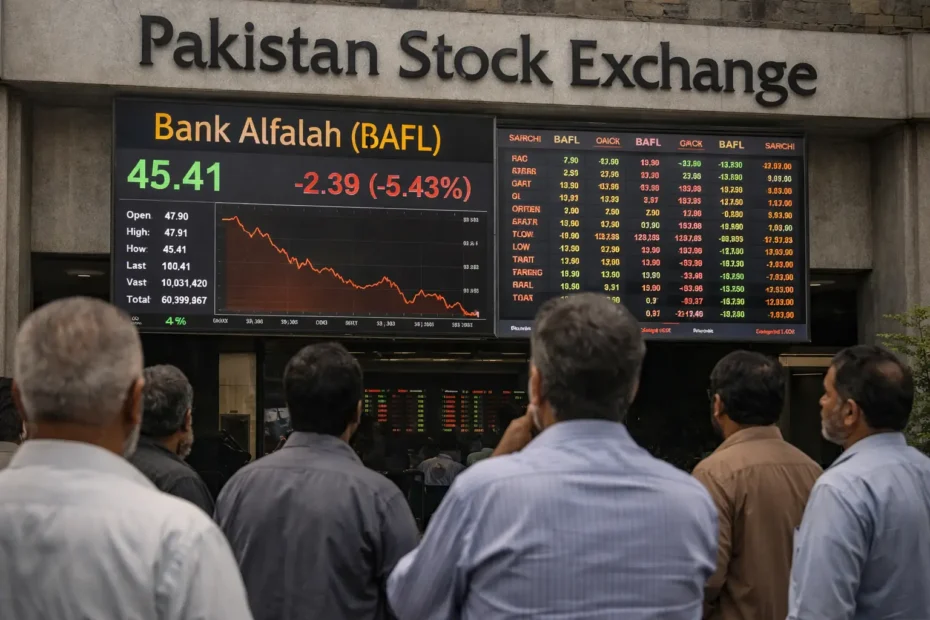
The KSE-100 Index closed at 150,398.71 on Friday, shedding 1,612.55 points or 1.06% in a session that extended the worst weekly selloff Pakistan’s equity market has suffered in months, as Pakistan’s record-high fuel prices and sustained Gulf conflict eroded investor confidence across every major sector. The close marks the third consecutive losing session and places the index precariously close to the 150,000 psychological support level that analysts now treat as the critical near-term floor.
Friday’s Session:
The market opened on a weak note, with the benchmark index dipping sharply below the 149,000 level, hitting an intraday low of 148,796.54 early in the session. However, the decline was short-lived as strong intraday buying emerged, pushing the market swiftly higher, with the index climbing to an intraday high of 152,103. In the afternoon, renewed selling pressure dominated toward the end, with the benchmark index settling at 150,398.71, down by 1,612.55 points or 1.06%.
| Metric | Friday 4 April 2026 | Thursday 3 April 2026 | Change |
|---|---|---|---|
| KSE-100 Close | 150,398.71 | 152,011.26 | −1,612.55 (−1.06%) |
| Intraday Low | 148,796.54 | — | — |
| Intraday High | 152,103.00 | — | — |
| Volume (Ready Market) | 471.94 million shares | 352.27 million shares | +34% |
| Traded Value | Rs 24.644 billion | Rs 19.512 billion | +26% |
| Market Cap | Rs 16.725 trillion | Rs 16.883 trillion | −Rs 158 billion |
| Advances | 132 | — | — |
| Declines | 279 | — | — |
| Unchanged | 72 | — | — |
Source: PSX official data, 4 April 2026.
Which Sectors and Stocks Led the Selloff
Selling pressure was evident across automobile assemblers, cement, commercial banks, and fertiliser. Heavyweight stocks including LUCK, HBL, MCB, MEBL, NBP, ENGRO, and FFC all closed in negative territory.
Top negative contributors to the index were UBL, ENGROH, FFC, SYS, and LUCK, which together erased 1,100 points from the benchmark.
Cnergyico PK topped the volume chart with 97.208 million shares, followed by WorldCall Telecom with 28.342 million shares and Pak Refinery with 24.216 million shares.
The Week in Full — A 0.9% Weekly Decline
Arif Habib Limited (AHL) noted that Pakistan’s stock market remained under pressure during the week, with the KSE-100 index declining 0.9% week-on-week to close just above the key psychological support level of 150,000. Despite the overall negative trend, select heavyweights provided some support — 21 shares contributed a cumulative 79 index points, led by Meezan Bank (+5.97%), Engro Fertilisers (+5.88%), and Pakistan Oilfields (+1.93%). Major laggards included UBL (−4.44%), Engro Holdings (−2.94%), and Fauji Fertiliser (−0.85%).
Thursday’s session set the tone. The KSE-100 Index had closed Thursday at 152,011.26 points, down 3,500.30 points or 2.25%, following broad-based selling triggered by negative global cues and the government’s announcement of Pakistan’s largest-ever fuel price hike — petrol up Rs 137 per litre to Rs 458.41 (+43%) and diesel up Rs 185 per litre to Rs 520.35 (+55%).
What Analysts Said
“While the bleeding has slowed compared to yesterday’s panic, the combination of a record fuel price hike and escalating geopolitical tensions continues to weigh heavily on investor sentiment,” said Behtari Capital on Friday.
Topline Securities said: “Another negative session was observed at the exchange after the government’s announcement to end fuel subsidy, whereby diesel prices were increased by 55% and petrol prices by 43%.”
On the economic front, Pakistan’s trade deficit increased by 22.65% to $27.81 billion in the first nine months of FY2025–26, compared to $22.67 billion in the same period last year, according to data released by the Pakistan Bureau of Statistics. The trade deficit for March 2026 stood at $2.73 billion, up 3.71% year-on-year.
The Broader Context — PSX Among World’s Worst in Q1 2026
Pakistan’s equity market ranked among the worst-performing global markets in Q1 2026, with the KSE-100 Index declining approximately 15% — losses that intensified in March when the benchmark dropped 19,319 points or 11.5% month-on-month to close at 148,743. The index opened March at 152,717 points, hit a high of 161,475, and fell to a low of 144,119 points, reflecting sustained volatility driven by global oil price surges, with Arab Light and Oman/Dubai crude averaging above $100 per barrel and peaking near $135.
The index touched an all-time high of approximately 191,033 points in January 2026 before the Gulf conflict-driven correction began. At Friday’s close of 150,398.71, the market sits roughly 21% below that peak.
Friday’s close just above 150,000 makes that level the pivotal test for the week ahead. Investors holding positions in commercial banks, cement, auto, and fertiliser — the sectors hit hardest in the two-day selloff — now face a market priced for a prolonged high-oil, high-inflation environment. The PM’s Rs 80 petroleum levy cut announced late Friday night could provide a sentiment boost at Monday’s open, but diesel remaining at Rs 520.35 per litre keeps cost-of-production fears elevated for industrial and agriculture-linked stocks. Any rupee weakness against the dollar — already trading at Rs 279.10 — adds an additional layer of pressure on import-dependent listed companies’ earnings.