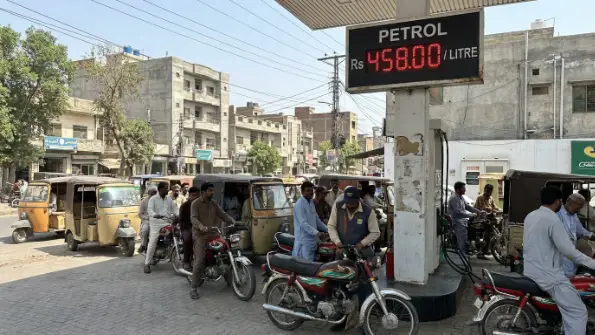
Pakistan Ranks 2nd Globally for Most Expensive Petrol Relative to Income — Only Ethiopia Worse
Pakistanis now pay more for petrol relative to their income than almost every country on earth, ranking second worldwide behind only Ethiopia in income-adjusted fuel cost, according to data compiled by GlobalPetrolPrices.com as of 30 March 2026. The distinction arrives as petrol at Rs 321.17 per litre — itself a product of a Rs 55/litre emergency hike on 6 March 2026 — sits 24% above the Rs 266.17 rate that prevailed just weeks earlier, driven by the Strait of Hormuz disruptions following the US-Israel war with Iran.
The GlobalPetrolPrices.com platform, which tracks retail fuel rates across approximately 150 countries, uses an income-adjusted measure — petrol price as a share of average daily income — to determine real-world affordability.
Pakistan’s nominal gasoline price stands at USD 1.15 per litre, against a global average of USD 1.40 per litre. In raw USD terms Pakistan does not lead the world. But when fuel cost is measured against what citizens earn, the picture turns stark: Pakistan’s low per-capita income converts what looks like a sub-average nominal price into one of the most punishing fuel bills on the planet.
Pakistan collects around Rs 84 per litre as petroleum levy on petrol and roughly Rs 76 per litre on high-speed diesel, meaning fuel carries heavy taxation on top of import costs. That levy floor — locked in under IMF programme commitments — means prices cannot fall meaningfully even if crude softens.
How Pakistan Got Here
The revised prices took effect on Saturday, 6 March 2026, immediately after a government announcement tied to Middle East tensions pushing commodity markets into a state of panic. The IMF had earlier demanded that the federal government pass on rising petroleum costs to consumers and avoid providing subsidies on petrol and diesel.
The Petroleum Development Levy on petrol stood at roughly Rs 10/litre in 2020. By 2025–2026 it reached Rs 60–70/litre — making it one of the largest contributors to the current high petrol price in Pakistan. Under the IMF programme, Pakistan committed to maintaining PDL at high levels as a revenue measure.
The government has already spent over Rs 129 billion in subsidies to keep petrol prices stable, with a cap of Rs 158 billion — leaving authorities little room to absorb further shocks. An estimated gap of around Rs 100 per litre now exists between the official price and the unsubsidised market rate.
On 27 March 2026, Prime Minister Shehbaz Sharif rejected a fresh recommendation for another general fuel price hike, choosing instead to hold the rate at Rs 321.17/litre through at least the first fortnight of April.
The Iran War Factor
Pakistan is among dozens of countries that have recorded big increases in petrol prices following the escalation of the US-Israel war with Iran, which has disrupted global energy markets. The surge is largely driven by disruptions in the Strait of Hormuz, a critical global oil transit route.
Pakistan imports about 80 percent of its energy from the Gulf and has lurched between economic crises for years — and authorities have scrambled to roll out measures to conserve fuel. Government offices now operate a four-day workweek. Schools have closed. A 50% work-from-home policy is in effect.
Pakistan, Bangladesh, Sri Lanka, Jordan, Senegal, Egypt, Angola, Ethiopia, and Zambia are among the most at-risk economies, according to a recent analysis by the Washington-based Centre for Global Development, which examined dependence on fuel imports, public debt levels, and foreign exchange reserve ratios.
What the Numbers Show
| Fuel Type | Current Price | 15-Day Change |
|---|---|---|
| Petrol (MS 92 RON) | Rs 321.17/litre | +Rs 55.00 |
| High-Speed Diesel (HSD) | Rs 335.86/litre | +Rs 55.00 |
| Kerosene Oil | Rs 358.81/litre | +Rs 40.00 |
| High Octane (HOBC) | Rs 535.00/litre | +Rs 206.00 |
Sources: OGRA official notification, Ministry of Energy (Petroleum Division), 14 March 2026; HOBC rate per PMO notification 22 March 2026.
The PDL component alone now accounts for Rs 305.37 out of every Rs 535 litre of high octane petrol — more than 57% of what a consumer pays at the pump goes directly to the government as tax, not to the cost of the fuel itself.
Khalid Waleed, a research fellow at the Sustainable Development Policy Institute (SDPI) in Islamabad, warned of imminent food price spillovers. “Diesel is the backbone of Pakistan’s freight and agricultural economy,” Waleed said. “Trucking costs have started climbing, and that will feed into everything from flour to fertiliser in the weeks ahead.”
Waleed added that with Pakistan’s wheat harvest now under way in April, combine harvesters, threshers, and grain-transport trucks all run on high-speed diesel — meaning the current diesel price of Rs 335.86/litre will translate directly into flour and food price increases within weeks.
Every Pakistani motorcyclist, commuter, small business owner, and household budget feels this ranking directly. At Rs 321.17/litre, a full 10-litre fill for a motorcycle now costs Rs 3,212 — more than a day’s wage for millions of daily-wage workers. Transport fares, vegetable prices, school run costs, and courier charges will all continue to climb as long as petroleum levies remain structurally elevated under IMF conditionalities and the Strait of Hormuz stays disrupted.
Pingback: Why Pakistan’s Oil Diplomacy Isn’t Lowering Prices - Ceylon Wire - English