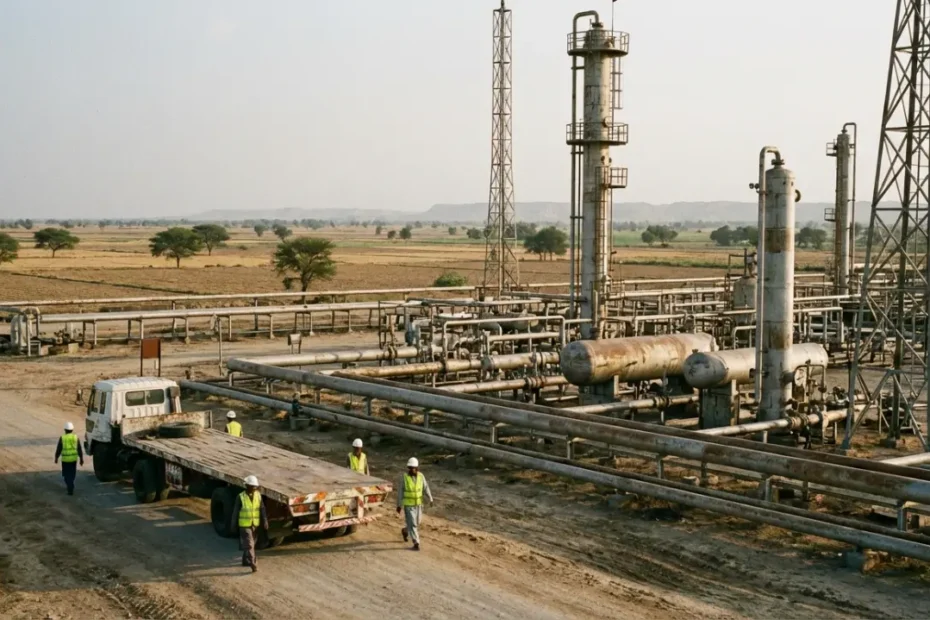
China Presses Pakistan to Clear $220 Million in Gas Dues Owed to United Energy Pakistan
China formally urged Pakistan through diplomatic channels to settle $220 million in overdue payments owed to United Energy Pakistan (UEP), warning that continued delay risks staff layoffs at the Chinese-owned gas producer and damages Pakistan’s credibility with foreign investors. The Special Investment Facilitation Council (SIFC) has also called for immediate resolution — but Sui Southern Gas Company, the debtor utility, says it cannot pay until the Federal Board of Revenue releases its own pending tax refunds worth billions of rupees.
The Chain of Debt — UEP to SSGC to FBR
Pakistan’s ambassador in Beijing sent an urgent note stressing that the dues relate to gas supplied by UEP to Sui Southern Gas Company (SSGC), which currently receives 260–270 million cubic feet per day from UEP.
SSGC has maintained that it cannot settle the payments until its own refunds — amounting to billions of rupees — are released by the Federal Board of Revenue.
The payment blockage therefore runs three levels deep: FBR owes refunds to SSGC → SSGC owes gas payments to UEP → UEP owes operational continuity to the 260–270 mmcfd it supplies daily to Karachi and Sindh’s gas grid.
| Entity | Role | Obligation |
|---|---|---|
| United Energy Pakistan (UEP) | Chinese-owned E&P company | Gas supplier to SSGC — owed $220 million |
| Sui Southern Gas Company (SSGC) | State utility | Gas buyer — blocked by FBR refund delay |
| Federal Board of Revenue (FBR) | Tax authority | Owes billions in pending tax refunds to SSGC |
| SIFC | Investment facilitation body | Demanding immediate clearance |
UEP Staff Layoffs Signal Operational Stress
Liquidity constraints linked to the delayed payments have recently forced UEP to lay off staff, according to a report by a national daily.
Pakistan’s SIFC called for an immediate resolution of the outstanding amount, warning that delays risk undermining confidence among foreign investors at a time when the country is seeking to attract external capital into its energy sector.
The layoffs at UEP are a direct operational consequence of a payment dispute that originates inside Pakistan’s own fiscal machinery — making FBR’s refund clearance the single most actionable lever available to break the deadlock.
Who Is United Energy Pakistan?
UEP acquired BP Pakistan’s assets in 2011, renaming the company. In 2012, it secured a $5 billion credit line from China Development Bank for local operations and potential acquisitions. In 2018, UEP acquired OMV’s gas fields in Pakistan for $192 million, expanding its portfolio further.
By 2019, UEP had become the largest foreign oil and gas E&P company in Pakistan, ranking 9th among all exporters with $227 million in exports. The company operates extensive gas fields across Sindh province — including Badin, Tando Muhammad Khan, Thatta, Hyderabad (rural), Matiari, Sanghar, Mirpurkhas, and Khairpur — and maintains four offshore exploration blocks in the Arabian Sea.
UEP is not a marginal player — it is Pakistan’s single largest foreign E&P operator, and any disruption to its Sindh gas fields would directly affect SSGC’s supply to millions of domestic and industrial consumers.
Why SIFC’s Warning Carries Weight
The SIFC — established in 2023 to fast-track foreign direct investment decisions — has positioned Pakistan as open to Gulf and Chinese capital in energy, mining, and agriculture. A public dispute over $220 million in unpaid gas dues to a Chinese company, escalated through Beijing’s diplomatic mission, cuts against that positioning at a critical moment.
Officials said resolving the payment dispute quickly is critical to sustaining UEP’s operations and preserving investor confidence in Pakistan’s energy sector, which continues to face mounting financial and regulatory pressures.
The dispute also lands at a politically sensitive moment. Pakistan’s broader circular debt crisis — which has seen Chinese CPEC power producers accumulate hundreds of billions in unpaid dues from CPPA — already strains the bilateral investment relationship. Adding a gas-sector payment dispute through a separate Chinese company signals that the payment reliability problem extends beyond the power sector.
For FBR, the SSGC refund blockage is a liability with strategic consequences — a tax refund delay that would normally be a routine fiscal management issue now carries a diplomatic dimension, with China’s embassy actively tracking resolution. For SSGC — a listed company on the PSX — unresolved payables to its largest gas supplier represent an operational and reputational risk that investors in SSGC stock should factor into their assessment of the utility’s financial position. For foreign E&P investors considering Pakistan’s upstream gas sector, UEP’s experience — being the country’s largest foreign operator and still unable to collect $220 million — sends a clear signal about payment risk in any gas supply arrangement with state-owned distribution utilities.